The Five Teas
The destruction of tea in Boston Harbor would not be deemed a “tea party” until the term was first used in 1829 when the Providence Patriot reported the death of a 97-year-old resident named Nicholas Campbell.
In his obituary, the newspaper reported Campbell “was one of the ever-memorable Boston Tea Party, who committed one of the first acts of resistance to British oppression.” These are the teas that were tossed:
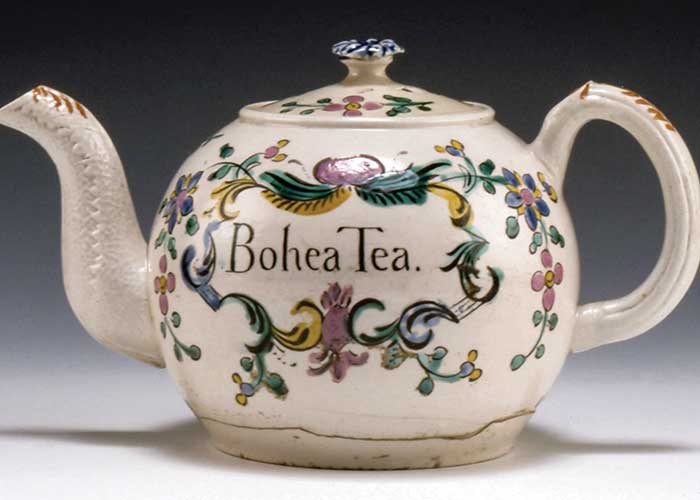
Bohea—This is a lower-grade black tea from China’s Wuyi Mountain region. All black teas were fired or dried over charcoal in tea gardens before being transported to London warehouses. Because this grade is composed of various leaf sizes, Bohea has a complex flavor often improved by adding milk and sugar. This tea was so common that colonial guests would often be invited to “share a cup of Bohea” rather than a cup of tea.
Congou—This was the finest grade black tea and was affordable only to the wealthiest households of Great Britain and Colonial America. It, too, was grown in the Wuyi Mountains region (modern-day Fujian Province.) Seventy percent of the tea the East India Company imported was this well-made black tea that brewed a deep transparent red liquor with a strong and pleasant bitter flavor.
Hyson—It may surprise you that one-third of the tea exported from China in the 18th century was green tea, with spring-picked Hyson being one of the favorites. The first tea plucked in the spring is always the finest, which the Chinese designated yu-tsien or “before the rains” tea. This green tea was a favorite of both George Washington and Thomas Jefferson.
Singlo—This expensive green tea from the Sunglo Mountains was picked later in the season when the tea leaves were larger. It tended to spoil sooner than other teas and was not widely known in the colonies. Singlo was only included in the ill-fated shipment because the East India Company had a lot of stock that needed to be liquidated before it became undrinkable. They wanted to introduce the tea to the colonies in hopes that Americans would develop a taste for it.
Souchong—This classic black tea from the Wuyi Mountains of Fujian province has a distinctive aroma. The original term souchong (xiaozhong) means “small leaf variety” and refers to a family of tea cultivars that have existed in this famous tea-growing region of Fujian since 1717. The souchong teas drunk by early colonists would have had a smoky aroma, which the tea leaves picked up during drying. Most of today’s souchong exports are intentionally smoked with smoldering pinewood and are called Lapsang souchong.