A Tea Party is Launched
On September 27, 1773, plans for the world’s largest tea liquidation sale commenced as the first of seven ships laden with 544,000 pounds—nearly 2,000 chests—of East India Company Chinese black and green teas set sail from the port of London, bound for four American cities. The ship Nancy was destined for New York, the Polly for Philadelphia, and the London for Charleston, South Carolina. Four ships, Eleanor, Dartmouth, Beaver, and William, sailed toward the port where defiance of British rule was the highest—Boston.
The Boston Gazette reported on October 18 that the tea was on the way and urged readers “to meddle with this pernicious Drug” by either returning the tea to Eng- land or by destroying it. Within weeks, protests swept the major cities along the Eastern Seaboard, fueled partly by tea smugglers, including John Hancock, who viewed the shipments as threatening their business.
Each shipload was consigned to a group of loyal colonial merchants whose names had been suggested by English merchants who traded with Americans. The four ships destined for Boston would arrive first, and residents in the other cities looked to Boston’s Sons of Liberty to set the rebellion’s course and refuse the tea to be landed.
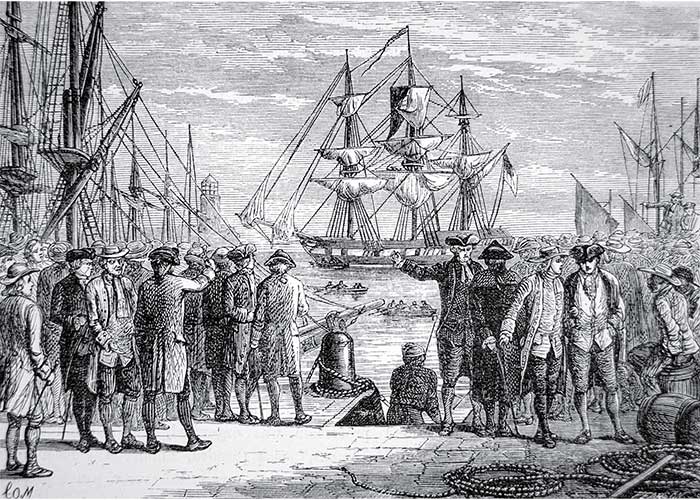
Nine weeks out of London, the Dartmouth was the first to arrive at the mouth of Boston Harbor on November 28. The ship, loaded with 114 chests of tea, docked at Fort William near the harbor entrance. Word spread quickly that the first of the tea ships had arrived, and 5,000 townspeople (one out of every three residents) gathered the next morning for a town meeting at Old South Church.
By British law, once the cargo had been inspected, the contents of the ship must be offloaded within 20 days, or the cargo could be confiscated by the governor—whose family was also a consignee—and sold at auction. The clock was ticking for the Sons of Liberty to act. This tea problem had to be decided before December 17.
On December 1, Captain Hall brought the Dartmouth to dock at Griffin’s Wharf, where the cargo, except for the tea, was put ashore. A contingent of 25 volunteers guarded the ship and ensured no tea came onto dry land.
On December 2, the ship Eleanor arrived, and on December 7, the brig Beaver tied up alongside. On December 10, the fourth Boston-bound tea ship, the William, ran into horrific trouble as it approached its destination. A dreadful gale ran the vessel onto the rocks off Cape Cod, and a second storm doomed the cargo of 58 chests of tea along with 300 new streetlights destined for the city of Boston.