Text by Bruce Richardson • Photography Courtesy of The Metropolitan Museum of Art
How did Britain become such a nation of tea drinkers? The answer is on display at The Met.
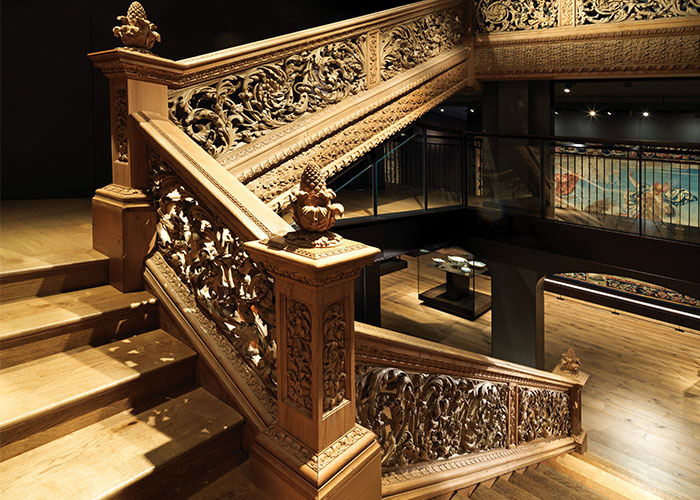
The Metropolitan Museum of Art in New York City has offered galleries displaying British decorative arts since 1910; however, a recent $22 million renovation gives visitors an insightful look into the influence of tea and trade upon the rise of the British empire. The updated 10-room display, which begins in the 16th century and winds up in the 19th, includes entire rooms plucked from long-gone mansions and a 17th-century staircase from stately Cassiobury House, demolished in 1927. At some point in its history at The Met, the stairs were disassembled and stored. Its numerous parts have now been found and returned to their original grandeur. You can climb them as if you were a duke or duchess.
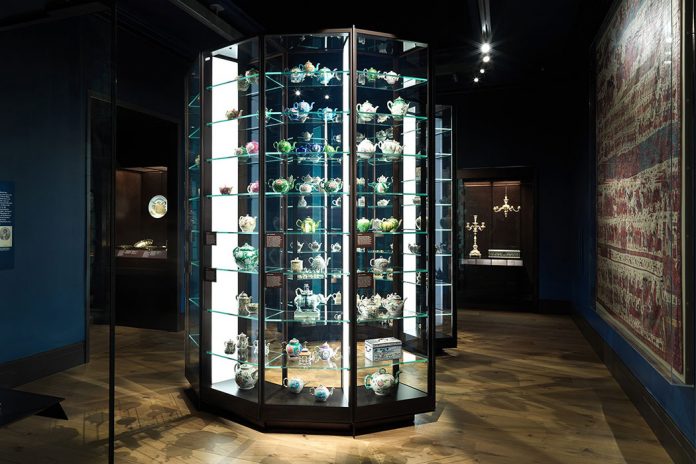
For teaists, the star of this Tea, Trade, and Empire exhibition comes soon after entering the gallery as visitors come face-to-face with a glittering light-filled curved display, featuring 100 British teapots—each with a unique story to tell.
“The case is meant to represent the world getting smaller with the trade of tea,” explains Wolf Burchard, Associate Curator.
A wall panel asks the essential question about the British love of tea, “How did an ancient Asian tradition become something quintessentially British?” Museum director Max Hollein notes that the department’s curators used 700 select artifacts to forge “a new narrative for the galleries that sheds light on four centuries of extraordinary artistic achievement alongside the realities of colonial rule.”
If you have ever tottered through the unending wall cases of teapots on display in London’s Victoria and Albert Museum or the acres of rooms at The Winterthur Museum in Delaware, you will likely find this focused presentation to be satisfying. The new Met exhibition is visual storytelling at its best.
Several key pieces help explain how tea became woven into the fabric of British life. These touchstones of history help us understand tea’s influence on commerce, culture, and community.