Lewis Carroll
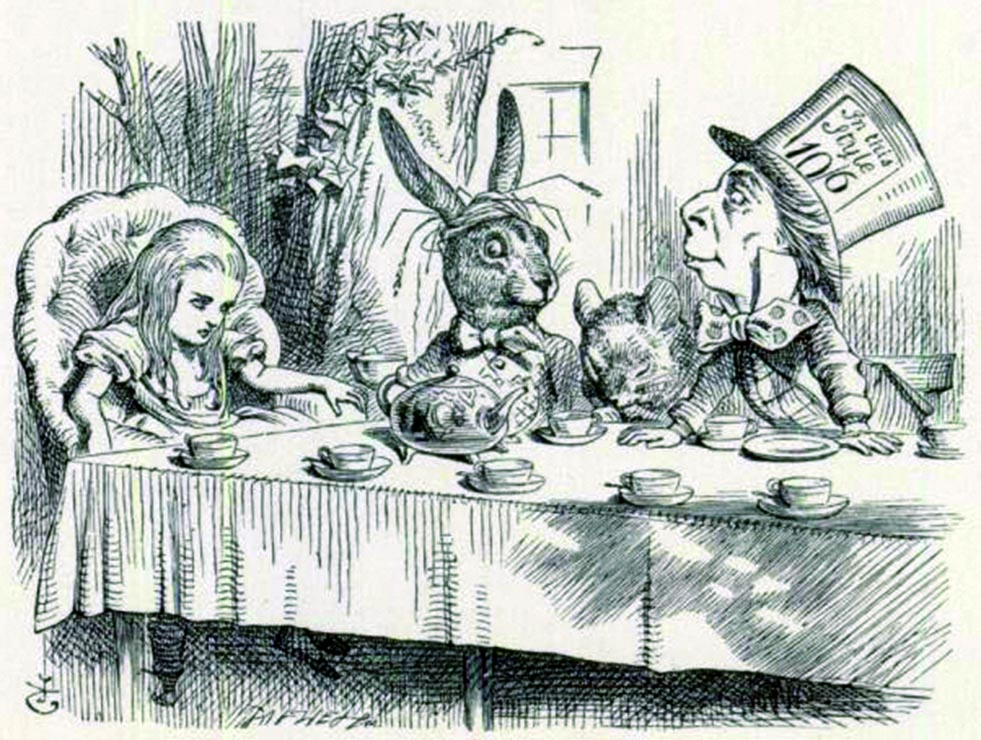
American readers might miss the complexities of the chapter “A Mad Tea-Party” in Alice’s Adventures in Wonderland because it plays on the ingrained ritual of teatime in Great Britain; thus, Lewis Carroll’s masterful scene is interpreted differently on the two sides of the Atlantic.
For Americans, a tea party is often viewed as a special event where dressed-up children and stuffed animals preside over the table. The tea party in Alice conforms to American expectations—it’s an occasion that relies on the power of the child’s imagination to function.
Yet, in Great Britain, tea is an everyday ceremony with specific boundaries. British readers have ingrained expectations of how Alice’s tea party should proceed; there is a precedent that is obviously not being followed here. To an American reader, what is expected, if whimsical, is highly abnormal and upsetting to a British one.
Alice’s attempts to instill order and discipline at the table seem natural if one considers the child Alice as the hostess. Yet she is only a guest, and her efforts to control other characters are, therefore, rude. The tea party ritual is violated, a subtlety Britains quickly grasp. Alice believes the tea ritual will provide her with everything missing since her tumble into Wonderland. This place feels like home, with all of its connotations of moral, spiritual, and physical comfort.
In short, Alice wishes to feel welcomed but does not. Thus, she attempts to control the situation as a hostess or disciplinarian, which the other participants dislike. But what some may see as a clever retort from the Mad Hatter—“ ‘Really, now you ask me,’ said Alice, very much confused, ‘I don’t think—’ ‘Then you shouldn’t talk,’ said the Hatter.”—British readers (and Alice herself ) view as an unforgivable violation of essential teatime manners.
The tea party violently breaks all expectations of decorum and respect for teatime rituals, and it is this lack of correctness, more than anything, that makes the tea party truly mad.
“Take some more tea,” the March Hare said earnestly to Alice.
“I’ve had nothing yet,” Alice replied in an offended tone: “so I can’t take more.”
“You mean you can’t take less,” said the Hatter: “It’s very easy to take more than nothing.”
It’s a great parody of refined teatime chatter. Everyone talks, but nobody listens or understands what anyone else is saying. In writing what sounds like nonsense, Carroll exposes the essential meaninglessness of the pleasantries we exchange daily.