By the 1770s, rococo had given way to the neoclassical style. In England, the architectural designs of brothers Robert, James, and John Adam simplified the lavish excesses of baroque and rococo with the lighter, more elegant neoclassical style, which also influenced the manufacturers of silver tea wares until around 1795. In 1807, in his Letters from England, under the pseudonym Don Manuel Álvarez Espriella, Robert Southey writes, “The breakfast-table is a cheerful sight. . . . The mistress sits at the head of the board, and opposite to her the boiling water smokes and sings in an urn of Etruscan shape.”
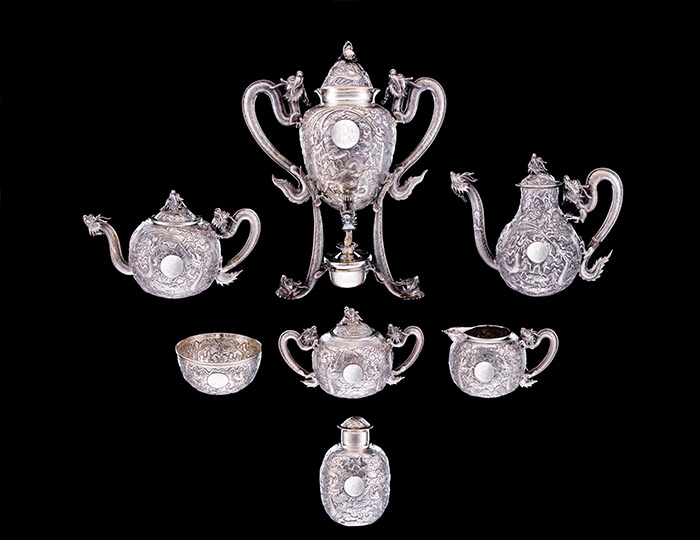
As has happened with porcelain and earthenwares made during the same period (Wedgwood was famed for his Etruscan pots and vases), silver pots, jugs, newly fashionable hot water urns, sugar baskets, and tea chests followed classical shapes and lines. These accoutrements were more simply decorated with fluting, beading (achieved with a small punch), piercing (carried out with a newly invented piercing saw), the application of medallions bearing classical themes or the heads of famous historical figures, ribbon work, scrolling, and borders of flowers and leaves.