
By 1672, the Duchess of Lauderdale owned a set of 18 silver tea bowls at Ham House, the large manor house west of London where Queen Catherine famously took tea with the duchess.
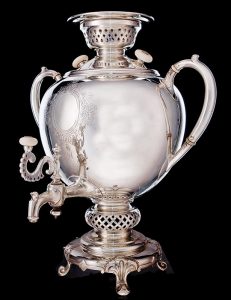
In 1688, the steward to the 1st Duke of Bedford bought a silver tea tray, then called a salver, for 5 shillings; in 1693, the aristocratic Bankes family of Dorset acquired, according to the household inventory, a silver “tea frame and kettle”; in 1697, the Earl of Dorset purchased a set of “6 guilt Tea spoons”; before 1701, Sir William Stoughton, Lieutenant Governor of Massachusetts, owned an American silver teapot; and in the early 1700s, Jacob Boelen of New York made a silver teapot that stood just 6½ inches high. By 1712, the earliest matching silver sets comprising teapot, kettle with tripod, tea jar or canister, sugar bowl, jugs for milk and cream, and a large silver tray were becoming available. Some of these also included teaspoons, sugar tongs, a mote spoon for removing stray leaves from bowls of tea, a boat for the teaspoons, and sometimes a mahogany table topped with silver.