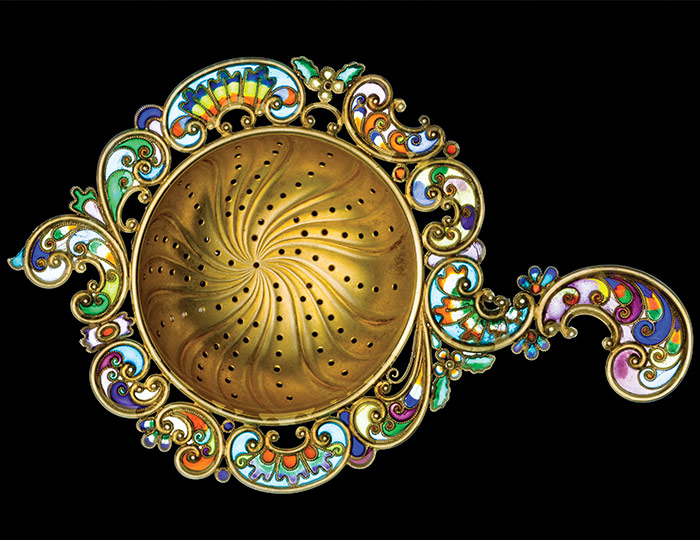
European designers and craftsmen greatly influenced each other’s work, and the same shapes and styles appeared in the different countries. In France, the influence of the rococo style in the early part of the 18th century was evident in the elaborate designs, swirling flowers, and extravagant scrolling used to decorate pots and kettles. Dutch silversmiths were influenced by the same late baroque flair, and the finest silver teapots and kettles, many produced in Friesland in the northwest of the Netherlands, were often beautifully embossed with similar rich ornamentation and dragonhead spouts.
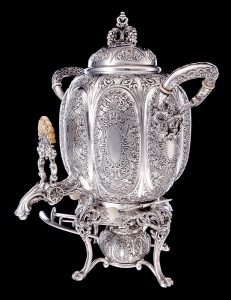
In America, Benjamin Burt and Paul Revere became famous for their rococo designs. (The Minneapolis Institute of Art owns a silver set comprising teapot and stand on four feet, cream jug, and sugar urn made by Revere.) In England, Paul de Lamerie, whose French Huguenot family arrived in London in 1689, loved the rococo style and became famous for the unity of form and decoration seen in his very sculptural pieces produced between 1730 and 1740. One of his most successful pieces was made in 1735 for the Boissier family and included a large silver-mounted chest with silver rococo lock, swing handle, and scroll feet, which contained three smaller chests (one marked S for sugar, one B for Bohea or black tea, and one G for green tea), a cream jug, 12 teaspoons, a mote spoon, a pair of sugar nips, and two knives with steel blades. All the pieces, except the mote spoon and sugar nips, bear the coat of arms of the Boissier family.