Text and Photograph by Bruce Richardson
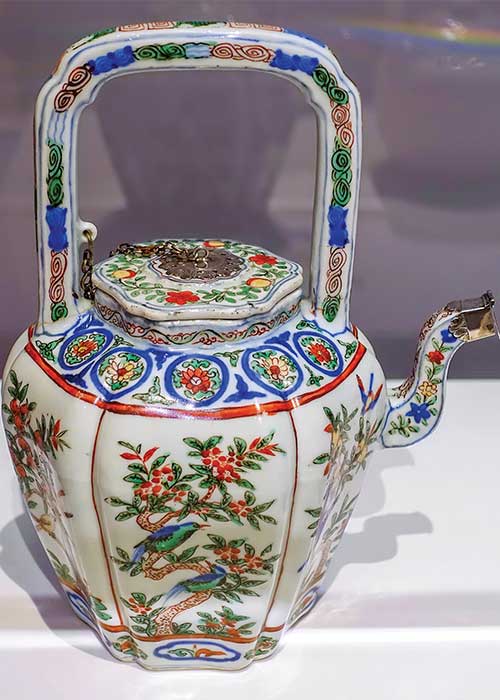
Tucked away in a glass display case of The Peabody Essex Museum in Salem, Massachusetts, stands one of the oldest and most valuable teapots in America. The 10-inch pot with a tall handle was made in Jingdezhen, China, in the 16th century. Decorated with paintings of songbirds and peach trees, it was one of the first pieces of imperial porcelain to arrive in England.
The exceptional piece was probably obtained by an English trader who presented it to Elizabeth I to curry favor at the time when the East India Company was about to receive its royal charter. The queen gave the unused Chinese teapot to her chaplain Henry Parry, the Bishop of Worcester, who was at her deathbed in 1603. Its value would have equaled that of a small house. Over the centuries, the heirloom passed through several families in private sales until 2007, when Sotheby’s London Auction House sold Elizabeth’s teapot for $1.4 million.
The rare teapot was highly sought after because it is decorated in five colors (Wucai), while the majority of Ming porcelain of this type is only painted in blue and white.
“It is a wonderful, exotic, and historic piece that would have blown people’s minds,” said Alastair Gibson of Sotheby’s. “You never saw porcelain in Europe then—it just didn’t exist. Everything was dull and tawdry, and people were mainly eating off metal. It symbolizes a new age of travel and exploration.”
As teapots go, it was an impractical utensil for the royal household because there would be no tea in England for another 50 years. Elizabeth I died without ever tasting tea. Chinese tea would not appear at Hampton Court until 1659 with the arrival of Charles II’s Portuguese bride, Catherine of Braganza. The Portuguese had been drinking tea for some time, and the teenage queen brought a small quantity with her when she arrived at the port of Winchester to meet her fiancé for the first time.
Although Elizabeth did not have tea in her palaces, she did have another exotic indulgence—sugar. Foreign dignitaries visiting the sovereign often remarked upon the shocking condition of Her Majesty’s teeth. They were rotten, a deplorable condition aggravated by her addiction to sugar.
Sugar consumption was a rare habit only rulers and wealthy merchants could afford at the beginning of the 17th century. Cones of hard brown sugar were imported via Arab traders and, eventually, from South American plantations owned by the Portuguese and Spanish. It was mainly used to sweeten herbs and medicines concocted by apothecaries.
By the late 1600s, the habit of adding a spoonful of sugar to hot tea spread from Hampton Court to urban households and rural cottages, and the term “teaspoon,” first mentioned in an advertisement in a 1686 edition of the London Gazette, was born.
In 1800, 30 million pounds of tea and 300 million pounds of sugar were imported to England. By the end of the century, the amount of imported tea had grown tenfold, and the average Englishman consumed 90 pounds of sugar each year—mainly via the teacup!
As Elizabeth’s exquisite teapot traded hands over four centuries, its owners might have been tempted to steep tea in their national heirloom. During the reign of Victoria, they would have poured Indian tea into Staffordshire cups and, in remembrance of their Chinese teapot’s royal heritage, added a few teaspoons of West Indies sugar to sweeten the ritual.
Contributing editor Bruce Richardson is the Master Tea Blender at Elmwood Inn Fine Teas and co-author of The New Tea Companion and A Social History of Tea, available at elmwoodinn.com.
Discover more seasonal recipes, table settings, and teatime inspiration by ordering your TeaTime subscription today!