Text and Photography by Bruce Richardson
We often forget that the British colonies of Colonial America were as immersed in the tea ritual on a scale equal to that of their English cousins, which helped spur the 1773 Boston Tea Party. Consequently, tea tables were necessary furnishings in the fine homes located in major port cities. As European furniture makers immigrated to the colonies, they set up shops in Boston, Philadelphia, New York, and Charleston, where they crafted and sold copies of British and Chinese tea tables to prominent families.
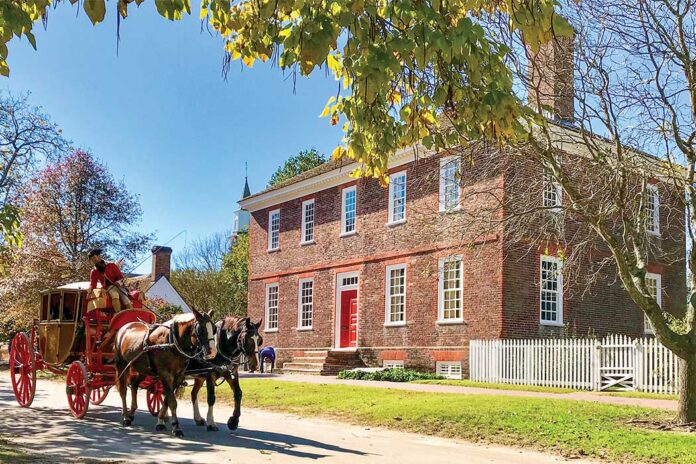
I was reminded of that booming industry during a recent visit to Colonial Williamsburg. I was there to visit the George Wythe House and later peruse the myriad tea things found in the DeWitt Wallace Decorative Arts Museum on the historic district’s edge.
My wife and I recently purchased a home in Kentucky modeled after the Wythe House. Perhaps the most handsome brick home in Williamsburg, the two-story residence is believed to have been designed in the mid-1750s by George Wythe’s father-in-law, Richard Taliaferro.
George Wythe mentored both Thomas Jefferson and Henry Clay in the study of law. In 1779, he joined the College of William & Mary to become the first law professor in the United States. General George Washington made the Wythe House his headquarters during the Battle of Yorktown. So, yes, the Wythe House proudly proclaims, “Washington slept here.”
A visit to Williamsburg’s DeWitt Wallace Decorative Arts Museum should be on every tea lover’s to-do list. Their extensive exhibits include countless tea artifacts that will fascinate you for hours. Two significant tea tables are in their collection.
Some of the first American-made tea tables were simple wooden trays on stands. Later versions—such as a 1750 Massachusetts tea table—were made with fixed tops and high-molded edges modeled after an earlier tray form. The tapered molding around the edge helped contain the delicate ceramics used while serving tea. Chinese tea tables inspired the cabriole legs.
The table originally belonged to Daniel Shute, the first minister of the South Hingham Massachusetts Church and delegate to the 1780 Massachusetts constitutional convention that ratified the federal Constitution. I can imagine the pastor’s family gathering around this table on December 17, 1773, discussing the rebellious actions that occurred the prior evening in Boston Harbor.
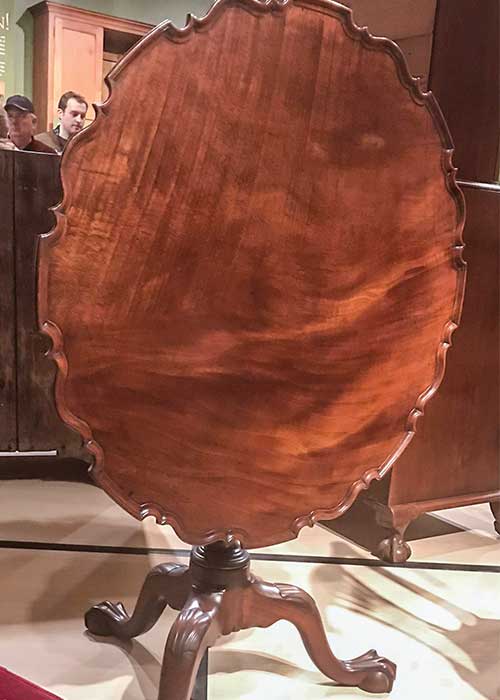
Until 1720, rectangular tea tables were the most common, but round tables with tilting tops later became fash- ionable. The hinged top was designed to store the table in a corner when it was not in use. As guests arrived for tea, the table would be brought to the center of the room where the tea things would be assembled.
This large tilting tea table was initially owned by merchant Daniel Barraud (b.1725) of Norfolk and later Smithfield, Virginia. The claw-footed table is attributed to Norfolk because of its history and the similarity of its turned shaft to those found on several other tables and stands with Norfolk associations. Norfolk supported a large and healthy cabinetmaking community by the third quarter of the 1700s.
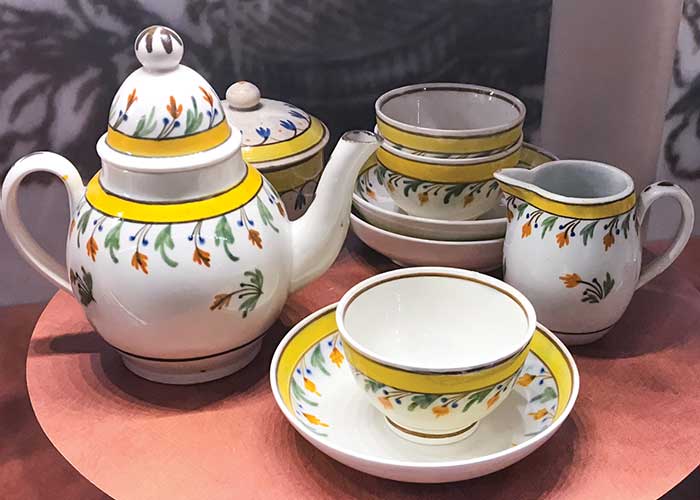
Lastly, I spotted a child’s tea set from the colonial era. This miniature tea set included a clipping from a Boston newspaper advertisement that appeared two years before The Boston Tea Party—“For Sale: Several complete Tea-Table Sets of Children’s cream-colored Toys. Boston News-Letter November 28, 1771.” Judging by its pristine condition, I suspect children never used this set.
Contributing editor Bruce Richardson is the Master Tea Blender at Elmwood Inn Fine Teas and co-author of The New Tea Companion and A Social History of Tea, available at elmwoodinn.com.