
Text and photography by Bruce Richardson
When you take a sip of tea, you are drinking a beverage grounded in a particular time and place. And no tea-growing region in the world is more grounded than China’s Yunnan province, home to pu-erh, where wild tea bushes, as old as a thousand years, can grow to be trees over 60 feet tall.
However, farmers in the western corner of Yunnan have noted a change in the weather in recent years, as the monsoon seasons continue to be more prolonged than usual. While extreme rain causes bushes to have beautiful leaves with increased budding, the resulting tea has a diluted taste and aroma. Subsequently, buyers and traders coming to these mountains will offer prices lower than usual.
Those of us who appreciate the taste of tea want to know what is happening within the leaf that brings about these distinct changes—these functional qualities—that influence how we perceive flavors. “Functional quality” refers to the therapeutic and flavor properties determined by concentrations of compounds known as secondary metabolites. Plants produce secondary metabolites to defend themselves against environmental stress—such as high solar radiation, extreme drought, or insect attacks.
For instance, the new leaves of the tea plant emerge as tapered emerald-green buds. These buds appeal to hungry insects that nibble on the tender shoots. Consequently, the tea bush protects its baby leaves by pumping a large amount of alkaline into those infantile buds. An unsuspecting grasshopper takes one small bite and is deterred by the bitter taste, the functional marker, or secondary metabolite, we know as caffeine.
But producing secondary metabolites is costly to plant metabolism, and plants will produce high concentrations of these compounds only when they need defense. Thus, secondary metabolite concentrations of individual plants will vary with stress.
Higher temperatures and extreme drought contribute to drier tea leaves with less budding. However, tea harvested during these stressful conditions can have a more intense taste and aroma, even as the yield is decreased by as much as 20 percent—as it was in the Himalayan gardens of Darjeeling this past year.
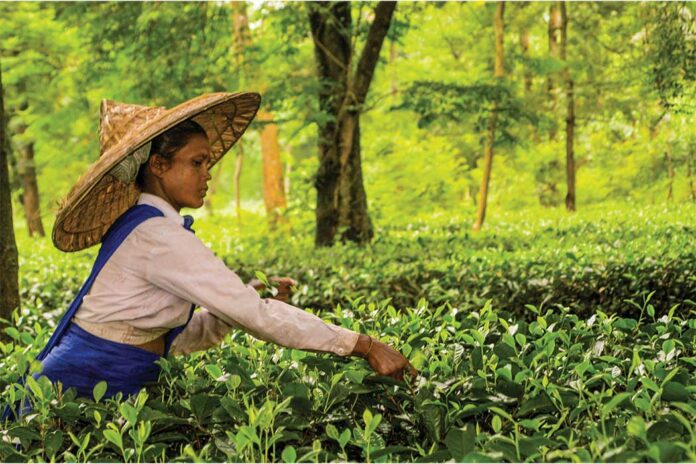
In India, 88 percent of Assam plantations said adverse climate conditions were a definite threat to their tea- growing operations in 2018. Changing weather patterns have pushed rainfall in Assam to the extremes, leading to more instances of drought followed by heavy rain. These downpours cause erosion and waterlogging of the soil, which damage root development and reduce the yield of the tea plants. Many tea farmers in Assam are taking steps to mitigate the effects of climate change with improved soil conservation practices and planting shade trees to shield the tea bushes from the sun’s harsh heat. Other producers are considering moving to the African interior as they search for more stable growing conditions.
Future consumers are likely to be drinking tea that has had to adapt to the climate. Thanks to secondary metabolites, some teas that have acclimated to stressful growing conditions might be tastier. However, as yields decrease, it is also possible that there might not be enough tea to satisfy demand. It depends upon how agile and innovative the global tea industry can be.
Contributing editor Bruce Richardson is the Master Tea Blender at Elmwood Inn Fine Teas and co-author of “The New Tea Companion: Third Edition,” available at elmwoodinn.com.