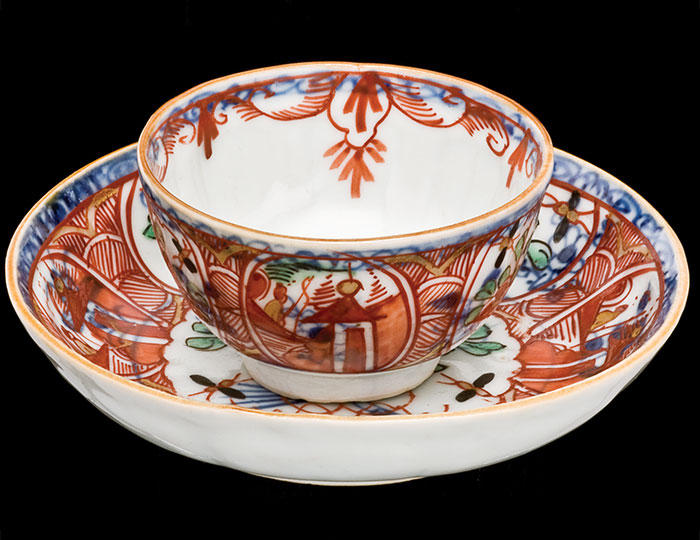
When America gained her independence in 1783, the country began trading with China for the first time. On February 22, 1784, The Empress of China, the first American vessel to be directly involved in that trade, set sail from New York for Canton. The captain and crew were recorded as being “all happy and cheerful, in good health and high spirits; . . . elated, on being considered the first instruments, in the hands of Providence, who have undertaken to extend the commerce of the United States of America to that distant and to us unexplored country.” And Philip Freneau, Poet of the American Revolution, included the following verse in his poem to celebrate the voyage, highlighting in one short line the reason for American tea drinkers’ anger against the British:
From thence their fragrant teas to bring
Without the leave of Britain’s King;
And Porcelain ware, enchased with gold,
The product of that finer mould.
But while America was helping boost China’s porcelain-export market, the demand for Chinese tea wares in Europe in the late 18th century dwindled as fashions changed and the European potteries learned to make their own pots, cups, and saucers in porcelain and stoneware.
Contributing Editor Jane Pettigrew, an international tea expert, who has written many books on the subject, is recipient of the British Empire Medal. A former tearoom owner, she is a much-sought-after consultant to tea businesses and hotels, a conference speaker, and an award-winning tea educator. Although her travels take her around the globe, she resides in London.
From TeaTime March/April 2017