Since it was during the Ming period that the first European merchants started trading with China, they learned to drink loose tea steeped in small pots and so shipped the tea, the ceramics, and the brewing method back to their own countries. The Portuguese were the first to trade directly with China, settling on the island of Macao in 1557, and by 1580, shops in Lisbon were selling fine Chinese porcelains. In 1602, Holland founded its East India Company and was the first European nation to import large quantities of porcelain, shipping around 3 million pieces between 1604 and 1657.
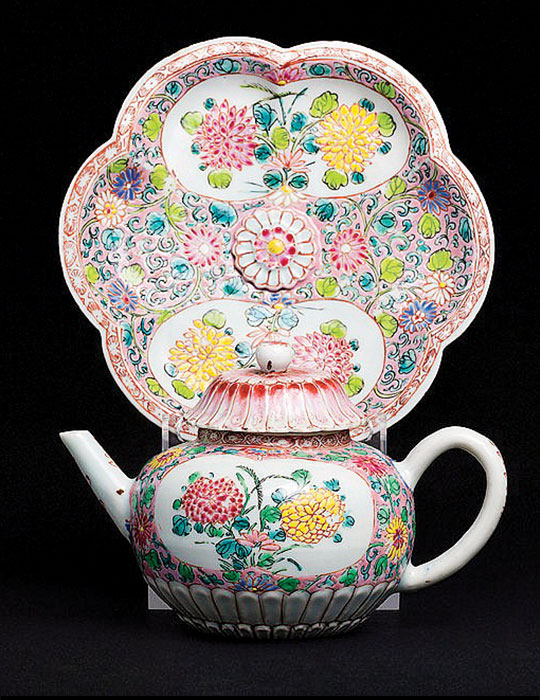
Through the second half of the 17th century, after the Qing Dynasty (A.D. 1644–1912) came to power, trade with Europe increased rapidly. The East India Companies of France, Denmark, Sweden, Austria, Prussia, and England also began buying Chinese ceramic wares, including ewers and pots. The difference between ewers for pouring and pots for steeping became more clearly defined at the end of the 17th century when the British East India Company directed that teapots made for them in China should have “a grate … before the spout,” to hold the leaves back when pouring.
Some of the most famous of these pots were produced in Jingdezhen in Jiangxi province. In 1787, Abbe Grosier wrote in A General Description of China, “Ching-tê Chen contains about five hundred furnaces for making porcelain . . . The flames and smoke which rise from them in different places, show even at a distance the extent and size of this celebrated village.” Jingdezhen was also the source of porcelains commissioned from abroad and decorated with designs specified by the customer. An anonymous American writer explained, “The china-ware is brought from the country (Ching-tê Chen) plain, and painted according to fancy in the city (Canton); they make us pay double price when they put a cipher on it, because they say it must go again into the kiln. They are great copyists and we have several sets of China to order with the family coat of arms.” As the trade in porcelain tea wares grew, more and more European customers sent orders via company agents to have teapots and bowls decorated with European scenes, family crests, monograms, or patriotic and political slogans.