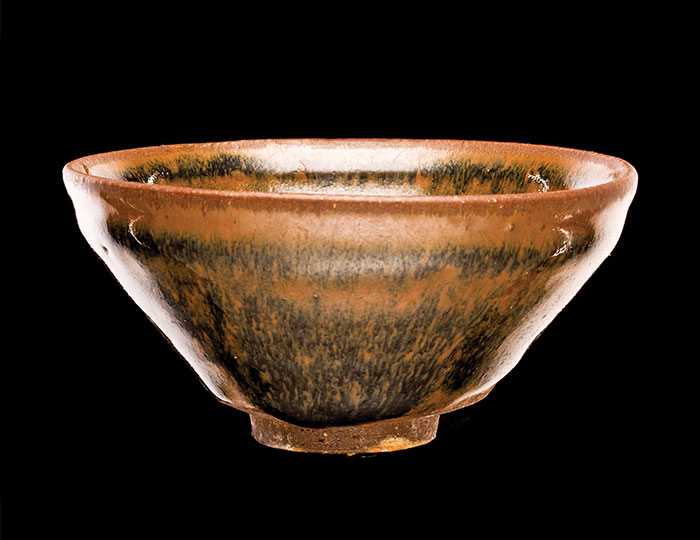
When we think of Chinese tea bowls today, we perhaps envisage the delicate white or pale-coloured porcelains that so artfully display the liquors of green and oolong teas. But during the Song Dynasty, tea bowls were glazed in dark colours. This is because white teas, made from the buds of wild tea trees, became very fashionable at court and were a favourite of Emperor Huizong. A book titled Chalu (The Record of Tea), written between 1049 and 1056 by Song scholar Cai Xiang, recommended the most suitable bowls for drinking these teas: “The tea drink is white in colour, and therefore should be contained in black cups. The froth of the tea is seen most clearly in a tea bowl with black glaze. . . . Its relatively thick body makes for a good way to keep the temperature of tea warm.”
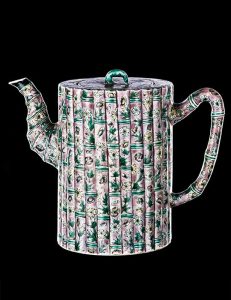
Toward the end of the Tang period and into the days of the Yuan Dynasty (A.D. 1271–1368), the ewers that had previously been used for pouring hot water onto powdered tea were now used to steep loose tea, as it became more popular. And when Taizu Zhu Yuanzheng, the first emperor of the Ming period (1368–1644), banned the manufacture of cake teas because their production was so labour intensive, leaf tea (known as Ming Tea), steeped in pots, was more and more widely consumed throughout China. Ming writer Ye Zigi (circa-1327–1390), recorded: “The people have stopped using powdered tea from Jiangxi; leaf tea is everywhere.” The loose tea leaves were rinsed in a sieve or colander with warm boiled water, then placed in a pot and steeped in hot boiled water for the length of time it took to inhale and exhale three times. The liquor was strained into bowls to warm them, then poured back into the pot and infused again for another three inhalations and exhalations.