
Then, in about 1740, a time when the English potters were still struggling to replicate true Chinese porcelain, creamware was invented and came closer to their goal than had any previous ceramic form. The body, sometimes thrown and sometimes pressed into moulds, was made from a malleable clay mixed with crushed, finely ground silicon and feldspar and sometimes also with kaolin clay. After firing at very high temperatures (1100–1200˚C/2012˚–2192˚F), it acquired a whitish color that was glazed with a light, transparent, cream-colored lead glaze. Staffordshire potter Thomas Whieldon, who established his pottery in Staffordshire in the 1740s, was the first to make this elegant type of ware. Josiah Wedgwood, who started his own company in 1759, also concentrated all his efforts on improving creamware.
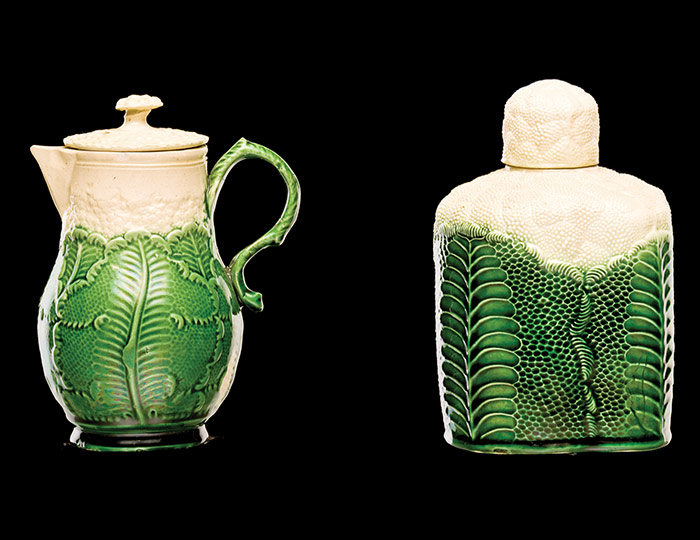 When Queen Charlotte ordered “A complete sett of tea things” from Wedgwood in 1765, Josiah was granted permission to rename his creamware Queen’s Ware and was appointed Potter to Her Majesty. Wedgwood also went on to create his famous blue-and-white jasper ware and black basalt ware, a black version of the jasper ware. Also famous for his creamware was William Greatbatch, who trained with Whieldon, worked independently for a number of years, and then joined Wedgwood. Greatbatch also used transfer printing to decorate his wares and produced “pearlware,” which was finished with a blue-tinted lead glaze colored with a tiny amount of cobalt. Before joining Wedgwood, Greatbatch designed and produced an impressive range of teapots in different shapes and forms, including cauliflower teapots, apple teapots, basketwork teapots, and squirrel and bird teapots. He also produced milk pots, cream boats, sugar dishes, spoon trays, butter tubs, and teapot stands.