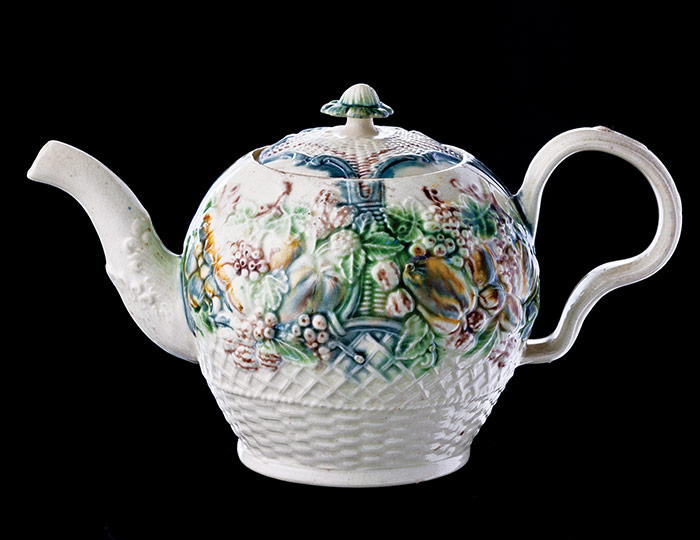
John Dwight of Fulham, London, and the Elers Brothers, who moved to England from Holland in the 1680s, started by making salt-glazed stoneware teapots in buff, red, and brown. The salt glaze was created by throwing salt into the hot kiln during firing. The soda in the salt combined with the silica and alumina in the clay to give the vessel a very thin glaze, which meant that any added relief work or decoration retained its definition. Other potters tried to parallel white Oriental porcelain by using a whitish, calcium-rich clay found in Devon. The pots were often decorated with shallow relief work, such as woven basketwork, in the same pale clay. Delftware techniques were also still popular: designs applied with brushes were covered with a transparent lead glaze, which gave a very smooth, shiny finish called “kwaart.” London potters at the Lambeth pottery used a Swedish form of decoration called bianco-sopra-bianco (white-on-white), which painted graceful designs, usually flowers, in opaque white over a gray-white ground to create a very elegant and delicate effect.