
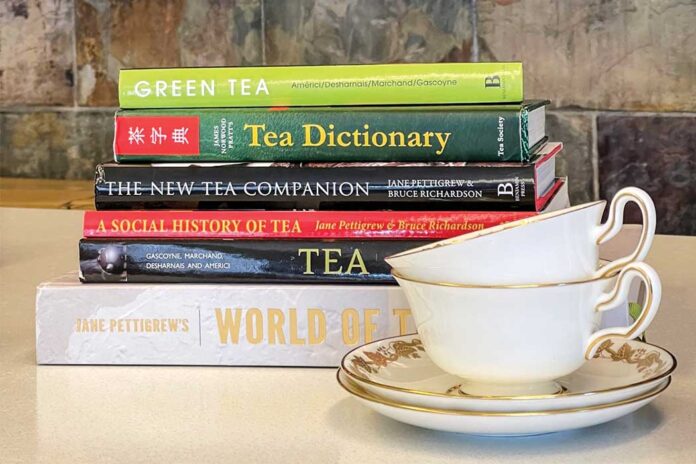
Text and Photography by Bruce Richardson
Being a loyal tea drinker requires mastering the tea lexicon. Over my three decades as a tea professional, I’ve answered countless customer questions as they attempt to communicate their preferences when ordering tea. Here are eight common terms that need to be in your teatime vocabulary.
Decaffeinated vs. Caffeine-free
True teas that have had caffeine stripped from their leaves using a CO2 process are correctly labeled as decaffeinated. However, as much as 20% of the blends in today’s market are naturally caffeine-free because they contain only fruits or herbs. I often hear tea drinkers request decaf teas when they mean caffeine-free teas, which are more plentiful in number.
Finish
When people talk about a tea’s “finish,” they’re referring to the physical and emotional impressions that remain after the tea has been tasted. Like a well-made wine, the finish can refer to the aftertaste, how long the flavors last until they fade, and the textural impact. A long finish is often taken as a sign of quality. Think of it as the memory the tea leaves in the mouth and mind after the cup is empty.
Non-GMO
This claim has begun appearing on some tea packaging, but it is irrelevant for tea drinkers because the Camellia sinensis (tea) plant is not a genetically modified crop.
Organic
To be labeled as organic, tea must contain 95% organic ingredients. The standards the United States government sets prohibit the use of synthetic fertilizers, pesticides, herbicides, or additives. It takes no less than three years for a garden to obtain this certification.
Pekoe
A customer recently complained that the Bi Lo Chun green tea she received was moldy because she observed fluff growing out of the unopened buds. That fluff—resembling the cilia on a baby’s ear lobe—has a Chinese name, Pekoe. The term is also used in tea grading to categorize the largest unbroken grades of Indian and Sri Lankan teas immediately below Orange Pekoe.
I need to remind readers that Orange is a tribute to the Dutch monarchy, who first imported Chinese tea into Europe and has nothing to do with the citrus fruit of the same name.
Single Garden
Many specialty teas are single-garden origin rather than blends. A single garden means the tea was grown in one garden—usually in one season—and not mixed with tea from other gardens or seasons. Blended teas combine teas from different regions to make a desired profile, such as Irish Blend or English Breakfast.
Tannins
If you’ve ever let your tea steep too long, you’ve felt the astringent, drying effect on your palate and mouth. It makes your teeth itch. This is the result of polyphenols or tannins. Tannins give tea and wine structure and texture. According to James Norwood Pratt, the term was adopted in the 1800s before it was understood that tea polyphenols have nothing in common with tannins found in tannic acid but do contribute to tea’s healthy properties.
Vegetative
Chinese green teas, plucked and wok-finished in early spring, often have a garden aroma and taste best described as vegetative or vegetal. In contrast, Japanese green teas, because they are steamed, are herbaceous or grassy in appearance and taste. These are positive characteristics we look for when evaluating the quality of green teas. These aromas are often released as soon as hot water hits the leaves in the teapot.
Contributing Editor Bruce Richardson is the Master Tea Blender at Elmwood Inn Fine Teas and co-author of The New Tea Companion and A Social History of Tea, available at elmwoodinn.com.



This guide is such a fun refresher on tea lingo—it really makes you appreciate every sip! I never realized how much nuance there was behind terms like “infusion” and “tannins.” Do you have any favorite teas that perfectly showcase these details? Thanks for the delightful read!