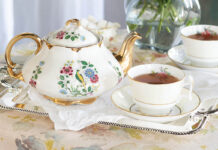

Europeans became aware of Chinese porcelain long before they showed any interest in Chinese tea. The first pieces arrived through Venice and other Italian ports in the 15th century. In the early 16th century, during the Ming Dynasty, the Portuguese started importing blue-and-white porcelain wares. As demand grew, Chinese potters began making items specifically for export to their European customers. In 1602 and 1604, the Dutch captured two Portuguese ships carrying thousands of pieces of porcelain, which were sold at auction in Holland and generated a growing interest amongst the wealthy.

Chinese porcelain was extremely expensive, and so European potters, not having the ability at that time to analyze it scientifically, attempted by trial and error to replicate it. The most successful recipe for “artificial” or “soft-paste porcelain” included clay and ground glass, and sometimes soapstone and lime, a mixture that held together quite well but often collapsed in the kiln. Italy was the earliest, in the 15th century, to experiment. Then in 1664, interest moved to Paris, where Claude Reverend applied for a monopoly of porcelain manufacture, and in 1673, Louis Poterat of Rouen in France was granted a privilege to make porcelain. But while European potters continued to make “artificial porcelain,” members of the various European royal families and rich aristocrats went on spending vast sums on their collections of Chinese porcelain.