Text by Jane Pettigrew Photography Courtesy of Dilmah Tea
The extraordinary legacy of Merrill J. Fernando
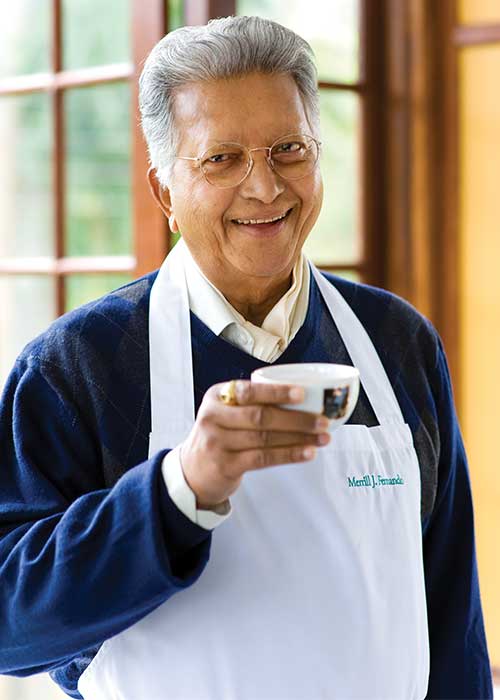
This is the story of Merrill J. Fernando, founder and owner of Dilmah Tea, Sri Lanka’s best-known and most successful tea brand. Merrill passed away in July 2023 at the age of 93, and people working in the tea industry around the world knew we had lost an extraordinary man. Merrill had devoted his life to tea and to the people of Sri Lanka—not just those who worked for and with him, but for the wider community for whom the beautiful island is home.
When asked about his love of tea, his vision for Dilmah Tea, and his determination—right up to the end of his life—to improve the lives of his employees and others struggling to make ends meet elsewhere in Sri Lanka, Merrill always said, “I am an ordinary farmer learning to market our tea crop without middlemen so I can retain in my country the earnings which are taken away by traders, leaving us poor. . . . I have made it my duty to extend a helping hand to others and the community. If we learn to care and share with others, we will spread happiness, not create envy. If we learn to share our wealth, our world will be a far happier place for all.” This wonderful attitude shaped him, his family, and Dilmah Ceylon Tea Company PLC.
A Life Devoted to Ceylon Tea
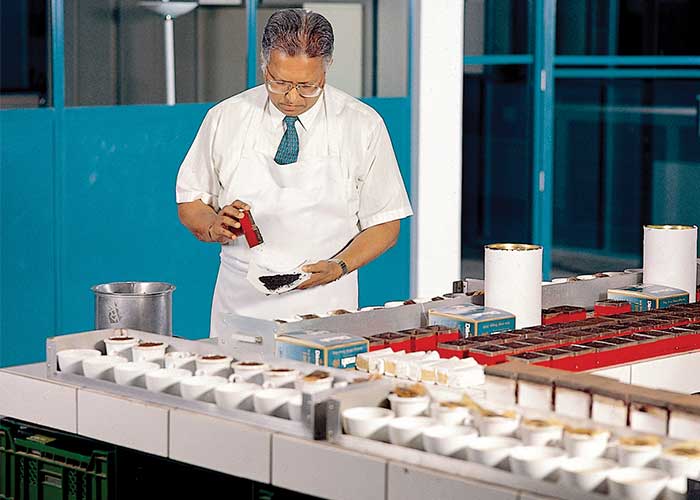
Merrill began his life in tea in Colombo when he was 20 years old, just two years after Ceylon (as it was then called) had gained independence from the British in 1948. He was determined to make tea his career, but until the early 1950s, the British refused to allow any non-British people in Ceylon to train as tea tasters. However, in 1950, the then Ceylonese Tea Commissioner eventually managed to persuade the British to create apprenticeships for local young men, and Merrill was among the first group of six to start training. To support himself, he began trading tea. Despite finishing his train- ing, Merril found that jobs in the Ceylon tea industry were still closed to him, but eventually he was offered a job with A F Jones, a British family-owned tea company in Colombo. He was sent to London to further his understanding of how the tea trade worked and quickly realised that tea quality was far less important than price to all the big blending companies in Britain. He saw that cheap teas from different origins were blended together and then sold as single-origin teas—for example, “Pure Ceylon” or “Pure Darjeeling.” Merrill understood that this was disastrous for Ceylon tea, as its prices were slightly higher than those for similar teas from India and East Africa. It was at this early point in his career that he understood how the approach of the Ceylon tea industry, the methods of marketing and selling Ceylon tea, and his own way of working had to change radically if the country’s tea industry was to survive and thrive.
In 1962, he branched out on his own and established MJF Co. Ltd., which, with the support of public officials who understood Merrill’s mission, grew and strengthened. His success encouraged him to continue to challenge the old order and break away from British control. Over the years, Merrill was blamed for upsetting the apple cart, and many of his friends turned against him. But, his quest was to change the system in Ceylon’s favour, and he was not giving up or giving in to anyone.
Dilmah is Born
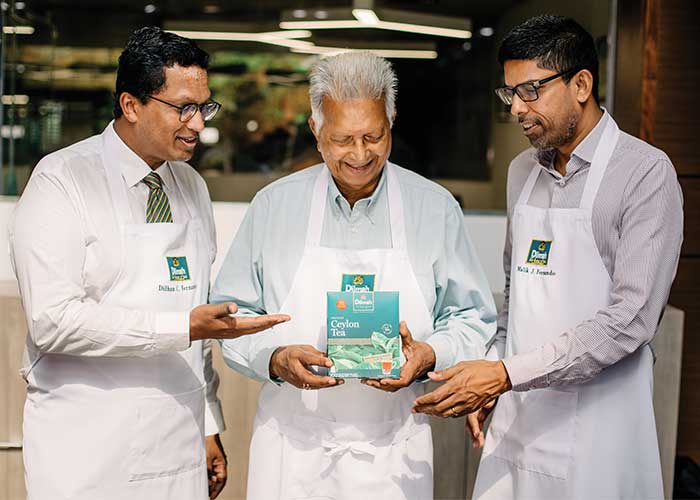
After Independence from Britain, the tea industry struggled due to the lingering vestiges of the British system, nationalisation of the tea estates and factories, the subsequent reversal of that policy by the government, political instability, increased labour costs, falling tea prices, and reduced demand from the big packers and blenders. Through all this, Merrill clung to his dream of creating a company that would one day export 100% pure Ceylon tea in packets that were ready to stack on supermarket shelves. So in 1988, he created a new company that would pack, brand, and export retail packets of the finest quality Ceylon tea. When choosing a name for his new company, inspiration came from within the family. At that time, his two sons Malik and Dilhan were small boys, and Merrill always referred to them as his “greatest asset.” So, he took part of each boy’s name, added an h to the end, and named his new venture “Dilmah.” At the time, Merrill said, “Both the packaging and the content had to be excellent because Dilmah was to be the third member of the family.” And he proclaimed, “I am not marketing tea. I am marketing a philosophy—the philosophy of caring and sharing, of giving everyone a fair deal. My business is a matter of human service.”