
Text by Barbara Gulley
Making fine china for royals and commoners for more than two centuries
On a busy street in Budapest, filled with pedestrians bustling through souvenirs shops and gathering at congested cafés, stands Herend, a serene and beautiful oasis. The luxury porcelain shop lies in the shadows of the many imposing spires of the 13th-century church named in honor of Saint Matthias. Though the high-end purveyor’s history isn’t quite as old as some of its neighboring landmarks, it boasts staying power of almost 200 years. In that time, it has attracted the impressive patronage of royalty, Hollywood celebrities, and aristocrats, both real and fictitious.

Vince Stingl started Herend in 1826 in its namesake town in Hungary, a little more than 50 miles from today’s Budapest. It was a costly endeavor, so to move it forward, he sold the manufacturing operation to Mor Fischer in 1839. The business was eventually handed down to Mor’s sons, then held by several owners before becoming nationalized after World War II. In 1992, Herend became an employee-owned entity, and today, employees own a 75 percent stake in the company.
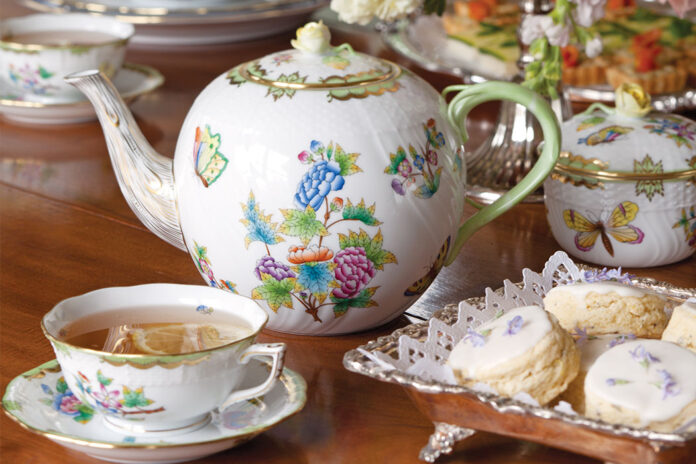
But, it was under Mor Fischer’s direction and his commitment to high quality and creative designs that Herend not only received awards for its craftsmanship but also caught the attention of a reigning monarch. At London’s first world’s expo, the Great Exhibition of 1851, one of Herend’s patterns on display received Queen Victoria’s admiration. She was so fond of the design that featured colorful peonies and butterflies that she commissioned a set for Windsor Castle. Herend later named it Queen Victoria in tribute to the royal.
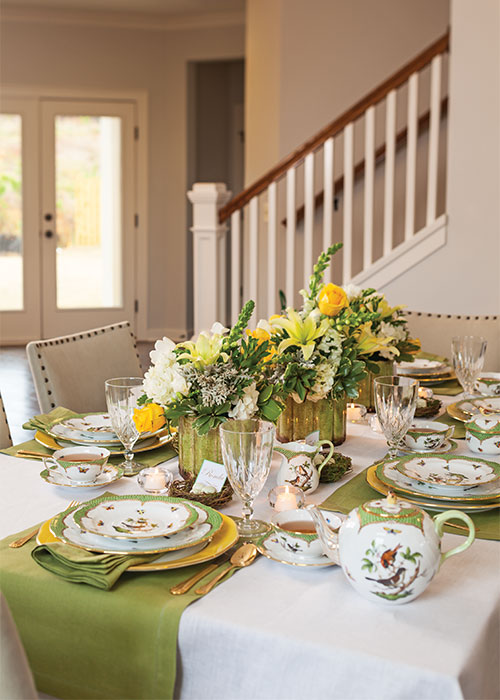
Another pattern named for a Herend supporter is the Rothschild Bird. The House of Rothschild, a banking family, provided Mor with loans that allowed him to expand the factory and increase production. He honored the financiers with china that not only espoused their surname but also featured a design inspired by a member of their family.
According to the legend, one day, while Baroness Rothschild was strolling through her garden in Vienna, she lost the pearl necklace she was wearing. An extensive search by her staff came up empty. Not until a few days later was it discovered by a gardener, who, on investigating a flurry of excited activity from a group of birds in a nearby tree, saw the necklace dangling from a branch. The Rothschild Bird pattern, accordingly, features two birds along with their pearled prize.




‘Very interesting. ‘want to now more about Herend…and to renew my TeaTime subscription.
What you call Chinese Bouquet is known to Hungarians as the Apponyi pattern as it was offered to Count Albert Apponyi a Hungarian Statesman in 1931, it exists in different colours, but the original was green