
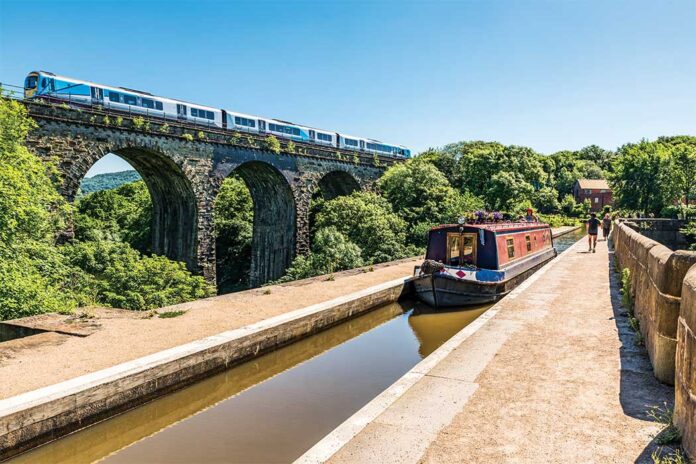
Text by Jane Pettigrew
Photograph Courtesy of Marketing Manchester, marketingmanchester.com
From industrial past to energetic present
Before the 18th century, Manchester was a flourishing market town that thrived on the wool trade. Then, at the beginning of the Industrial Revolution in the 1760s, it found itself at the heart of the cotton industry, as water-powered cotton mills sprang up in the north and east of the city. As weaving, spinning, and textile design expanded in nearby towns, Manchester became the marketplace and distribution centre for raw cotton and woven and spun yarn. Solid brick-built warehouses, smart office buildings, ostentatious banks, and a Royal Exchange, where traders met to do business every week, dominated the city. And, although the area also became important for engineering, foundries, and other heavy industry, by the mid-19th century, Manchester was affectionately known as Cottonopolis.
Today, Manchester is going through a period of revival and regeneration. Reclaimed warehouses have become bars, tearooms, restaurants, galleries, music venues, and performance spaces. It is young, vibrant, exciting, multicultural, cutting edge. It’s a city of festivals, fashion, a world-renowned music scene, markets, canals, art galleries, and museums—and plenty of good places to drink tea. Tea was, of course, extremely important during the noisy, relentless days of the cotton mills. As more and more people left farm jobs and took employment in the heavy mechanized industries, tea—made with safe boiled water, diluted with milk, and sweetened with sugar—offered the comfort of a hot drink and the caffeine and energy that helped workers keep going through long, grueling 10- or 12-hour shifts.
The following four hotels and tearooms, the best the city has to offer, all have close links to Manchester’s past industries but also fit naturally into its energetic present.




nice