
A trio of eclectic experiences
Text by Sharon McDonnell
A small arty town in southernmost Oregon, famous for its Oregon Shakespeare Festival since 1935, Ashland nestles in a valley between the Siskiyou and Cascade Mountain ranges. The town of approximately 20,000 possesses a charmingly cozy and New Age vibe, with eclectic independently owned shops, galleries, and many late-19th and early-20th century buildings. Deer often stroll in front of houses in daytime. Very suitably, a Cozy Mystery Festival was held here in late 2023, featuring authors of cozy crime fiction, a mystery solvable by finding clues around town, and murder-mystery dinners. It has many quaint B&Bs, but its most prominent landmark is the Ashland Springs Hotel, called the tallest building between Portland and San Francisco when it opened in 1925 as a whopping nine-story skyscraper. Ashland is also a place to sip tea in traditional, global, or Japanese style.
1. Lovejoy’s Tea Room of Ashland
96 North Main Street #201 • Ashland, OR 97520
541-708-6718 • lovejoystearoom-ashland.com
Before Muna Nash, a cheerful woman in pigtail braids, opened Lovejoy’s in Ashland—a treasure trove of antiques, mismatched floral teacups, vintage thrift shop finds, and broken-china mosaics—she co-owned Lovejoy’s in San Francisco for almost 20 years with a college friend she met decades ago. After the pair sold it in 2016, Muna opened Lovejoy’s in Ashland in 2021, during the COVID-19 pandemic. “I’ve been coming to Ashland for years and thought, I bet people would love to have tea somewhere.” The town seemed like a perfect fit, thanks to its Shakespeare festival and Elizabethan-style open-air stage, guaranteed to draw Anglophiles. “Finally, in January 2020, I thought, if I don’t do it now, I never will,” says Muna, who relocated to the vacation home she bought in Ashland. (Dobra Tea was already open when she opened her tearoom across the street, but they’re a study in contrasts. “Each has nothing to do with the other,” she notes. “I do classic afternoon tea.”)
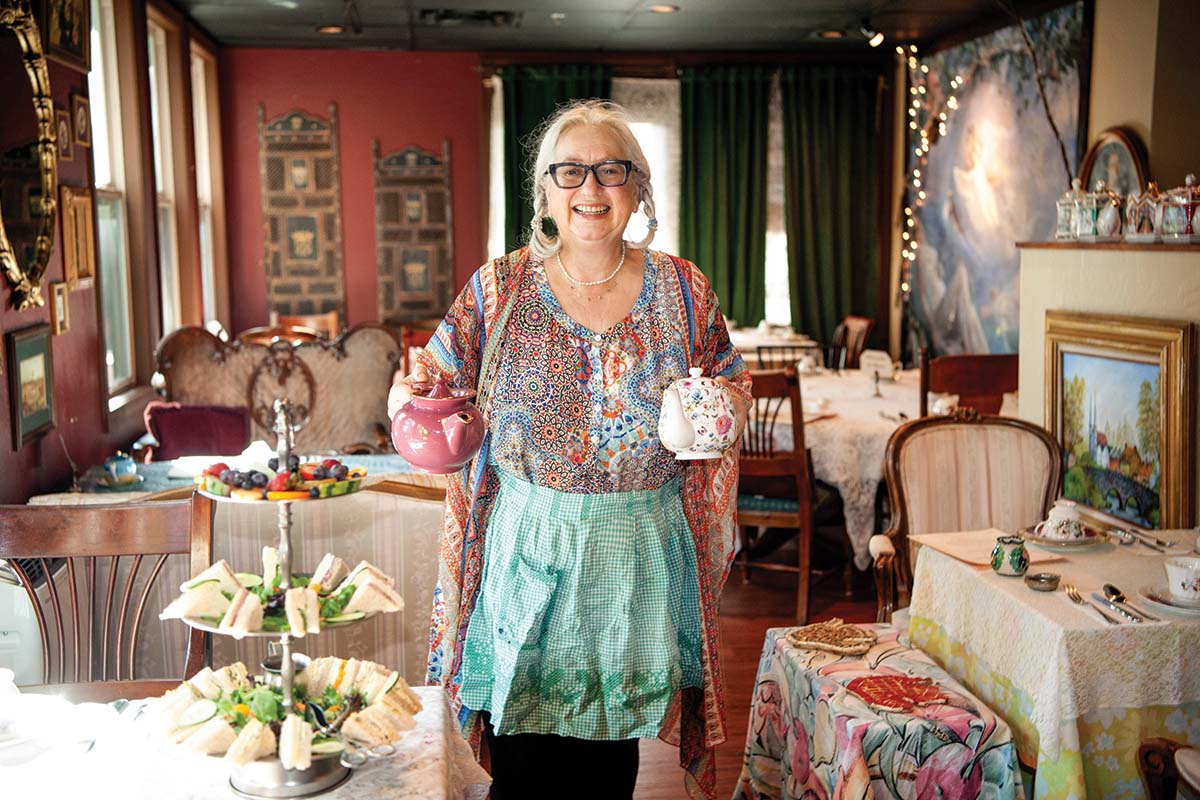
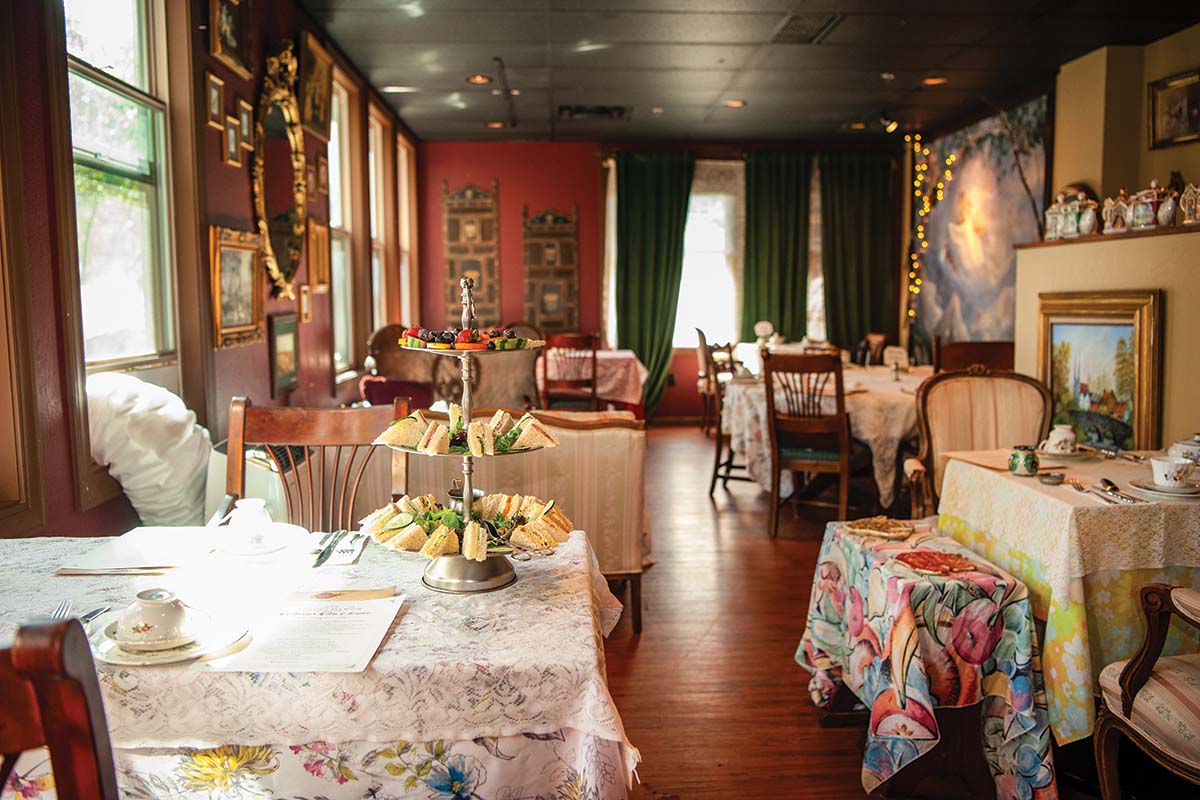
The Parlour Room in back, reserved for “Queen’s Tea” service, features a medieval-style tapestry of a woman with a lion and small animals (found in a Paris flea market), a Tiffany-style stained glass floral-patterned lamp and a sofa from her mother, a mural of an enchanted night scene from A Midsummer Night’s Dream, and her collection of Sadler teapots—some depict Shakespeare’s Romeo and Juliet and A Midsummer Night’s Dream, others depict English kings and queens. The front room (for walk-ins for tea, sandwiches, soups, and salads) has a shop selling teaware and gift items. The décor also features “little things that are wink-winks for followers of Lovejoy’s, like owls and British phone booths,” adds Muna, pointing out a tiny wall cabinet shaped like a classic British phone booth. Then there’s the bathroom, packed with portraits of dogs (some wearing tiaras and jeweled chokers), dog-themed ceramics, photographs, plus a sign that proclaims, “I work hard so my dog can have a better life.”
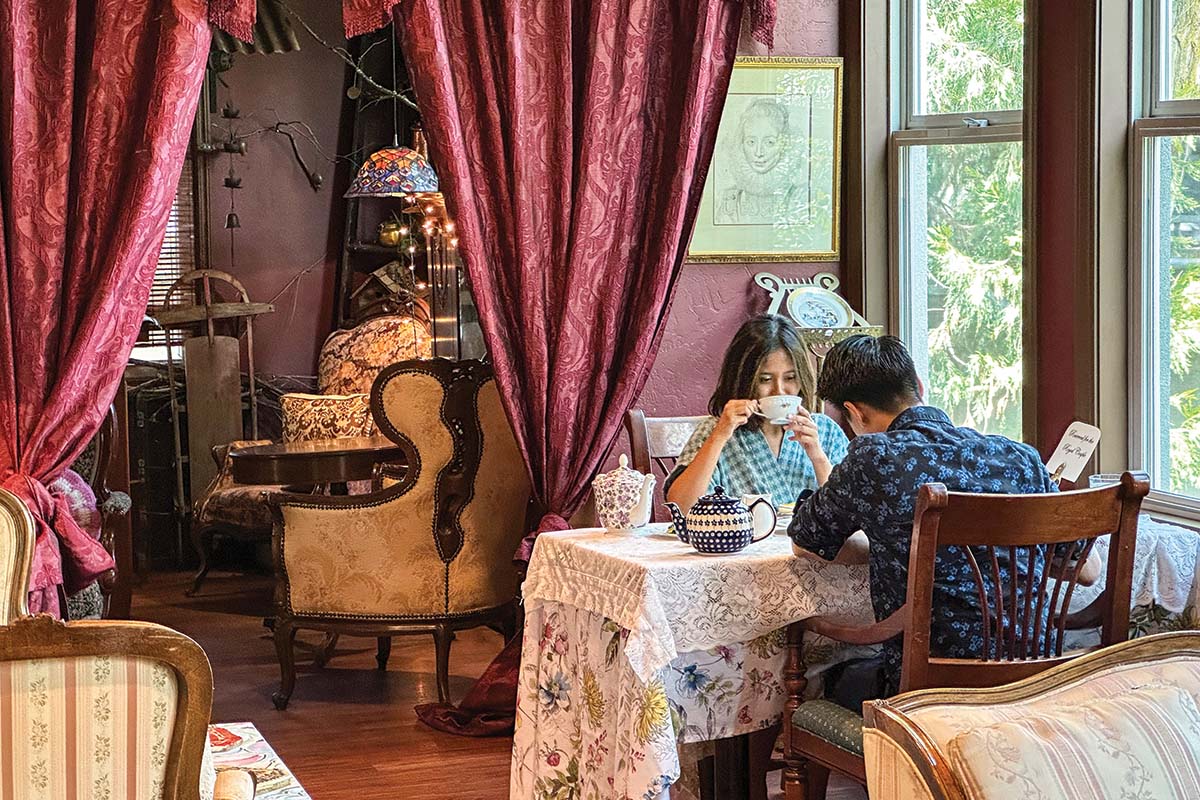
I am moved and drawn by unusual, eclectic, whimsical items. I don’t give much significance to their value or name recognition. If I like it, I buy it,” asserts Muna. It’s not a family trait. “My mother is very proper and was horrified at my décor when she came to tea. ‘The cups and saucers are mismatched on purpose,’ I overheard her tell her companions,” says Muna, a Northern California native who grew up in Costa Rica and Brazil, quit a PR job in her late 20s to travel the world, and ran a hostel for a few years in Ireland’s Wicklow Mountains that served tea on Sundays. “People are coming here for an experience—to be transported to a different world, to feel magic for a couple of hours. Some say it’s the highlight of their vacation here.” Others bring her collectibles from their families. “I feel like a repository,” she confesses.
During the Cozy Mystery Festival in October 2023, Lovejoy’s held a tea with festival founder Ellie Alexander, an author of cozy mysteries set in an Ashland bakery and an ex-resident of the town. In a cozy town like Ashland, Lovejoy’s is arguably the coziest spot. Bridal showers and birthday parties are often held here. Around Halloween, a Witches Tea sells out every year. Prizes for Best Witch Costume and Best Witch Hat are awarded, while squash soup made from tea-infused stock is on the menu.
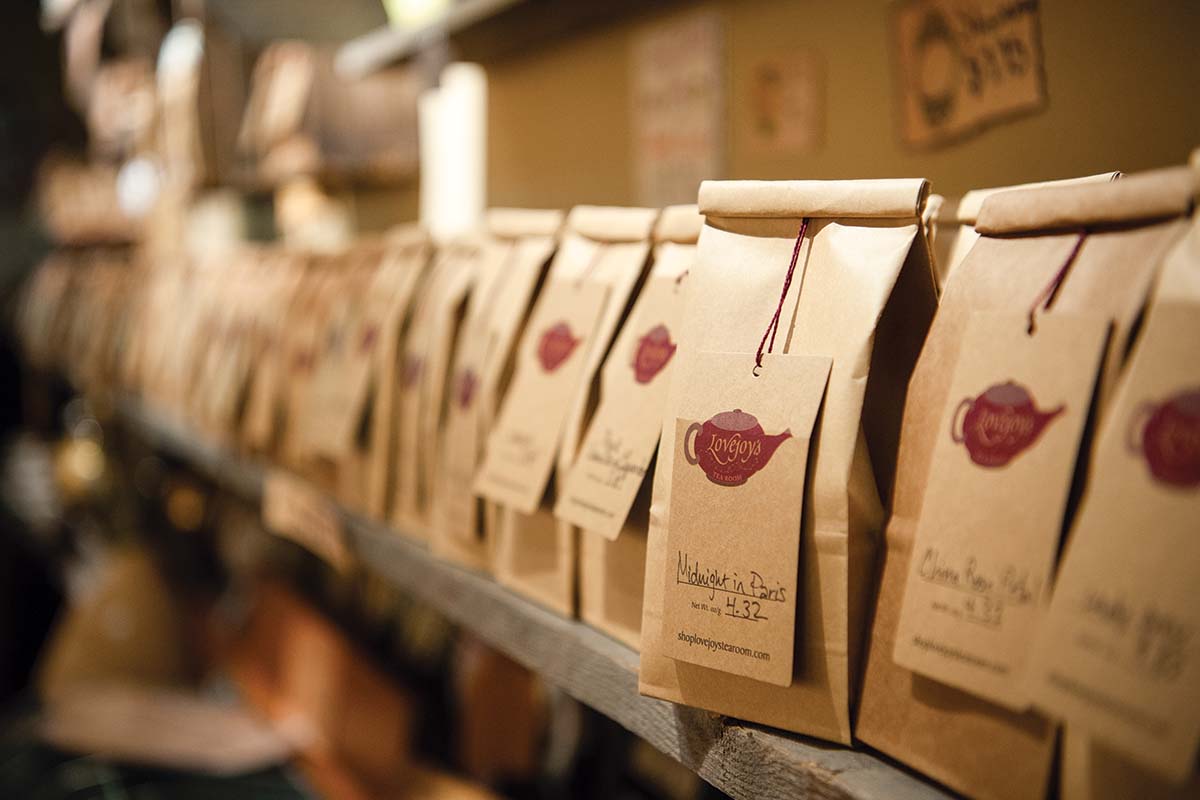
More than 50 teas are served, mostly from Taylors of Harrogate in England for black teas and Metropolitan Tea Company for Darjeeling and Pu-erh teas to her own blends. “Scottish Caramel Pu-erh is a house favorite—if tea were a beer, this would be a Guinness, dark, malty and strong,” explains Muna. “I love creating new floral blends, such as our signature Tea Room Blend of black tea with vanilla and lavender; Midnight in Paris, a blend of bergamot (the unique flavor in Earl Grey) with a hint of vanilla and lavender; Victorian Garden; and Ashland Fog.” The Queen’s Tea ($40) includes a choice of two sandwiches (chicken, apple, walnut, and cranberry salad; artichoke hummus with arugula and ham with sliced apples, greens, and Dijon or English mustard among them), a choice of two sweets (which include chocolates from Branson’s Chocolates in flavors such as pear, jasmine, or tea-infused); petit fours; a warm scone with Devonshire cream and preserves; and a crumpet with lemon curd, salad, and fruit.
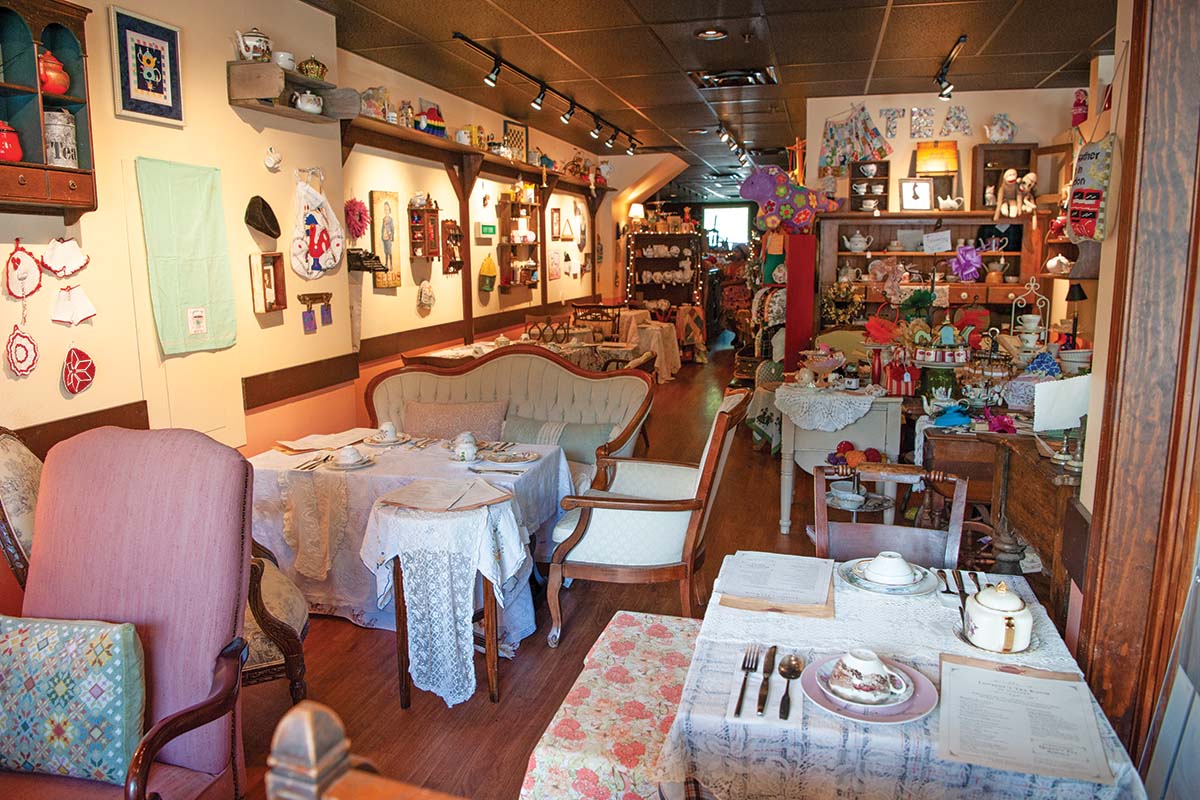
Muna and Gillian Briley, her college friend and former co-owner of Lovejoy’s in San Francisco, co-own Lovejoy’s Tearoom LLC, which offers licensing opportunities for tearooms that share their aesthetic. (Gillian now owns Lovey’s Tea Shoppe in Pacifica, a coastal suburb of San Francisco, with a former employee.)
Lovejoy’s Tea Room is open Thursday through Sunday from 11:00 a.m. to 5:00 p.m. Reservations are required for the Queen’s Tea, with seatings at 11:00 a.m.; 1:15, 1:30, 3:30, and 4:00 p.m.
2. Dobra Tea
75 North Main Street • Ashland, OR 97520
541-708-0264 • dobrateaashland.com
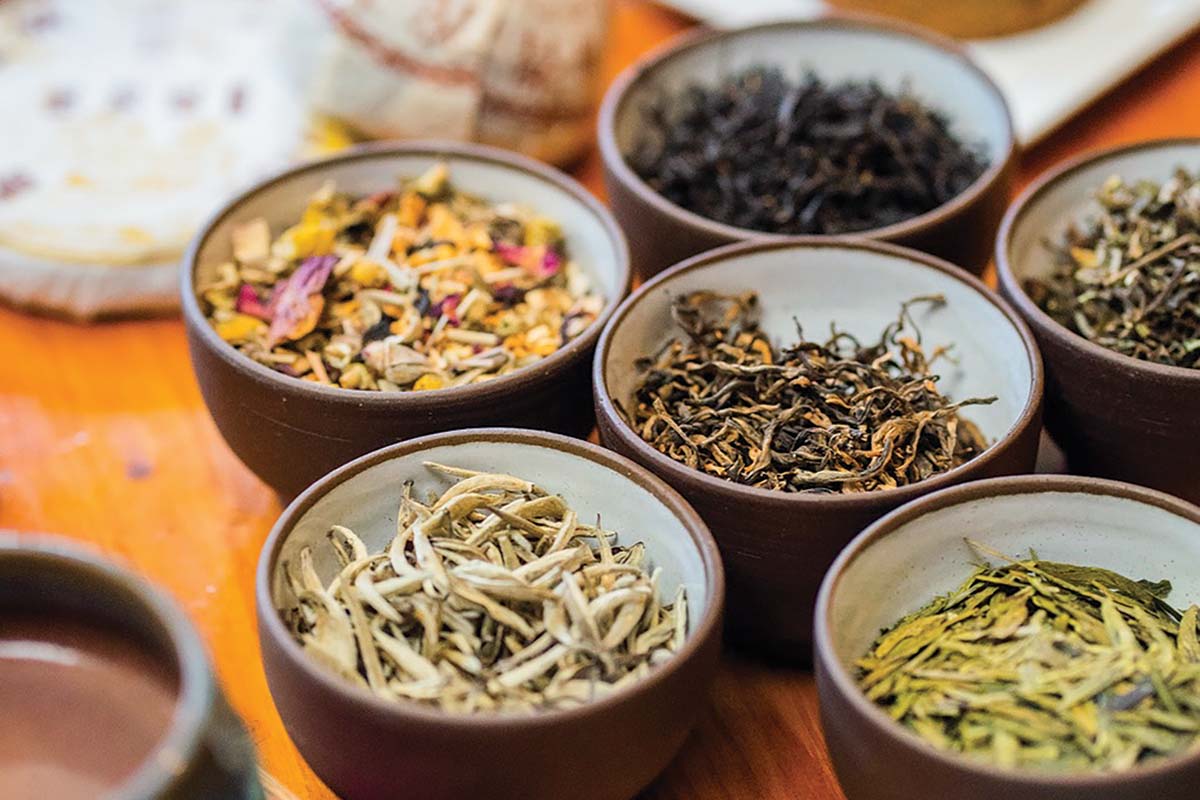
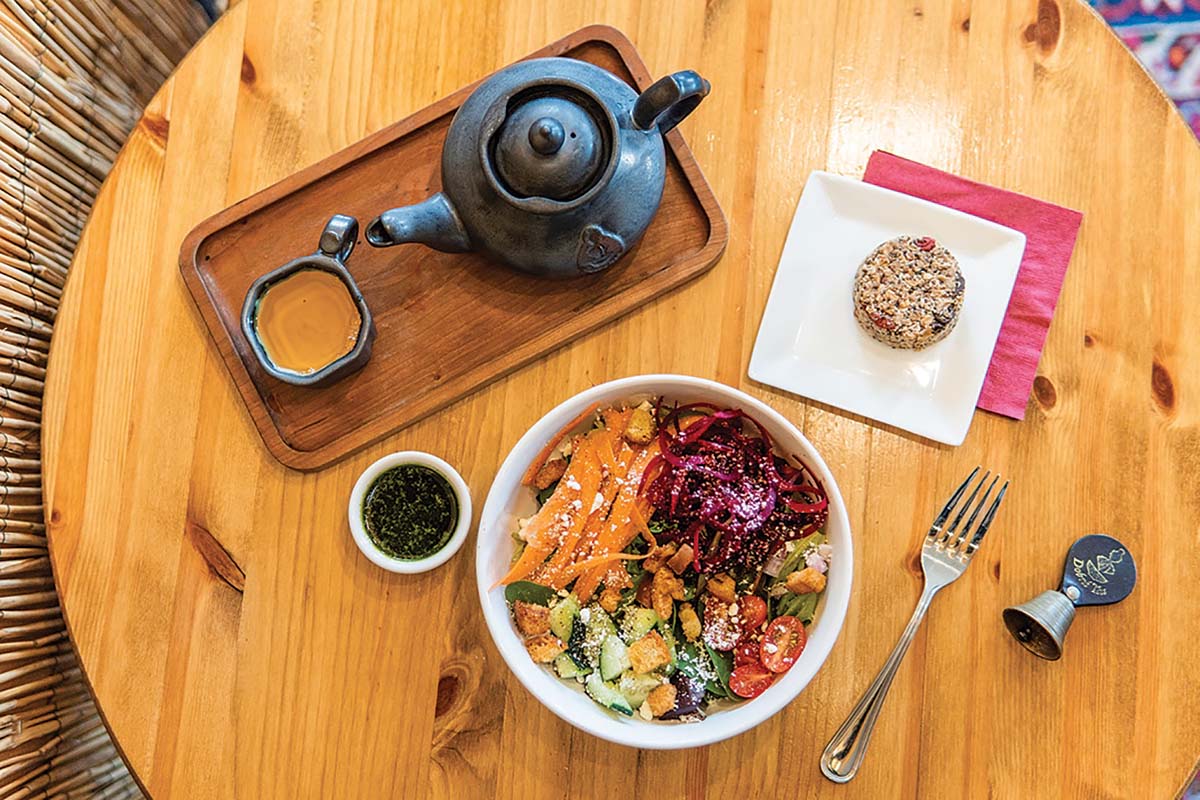
Two Moroccan-style seating areas—where you sit on cushions on the floor at low wood tables, by decorative tiles and a rug on the wall—are just one hint you’re in a global tearoom. The inch-thick tea menu, which describes more than 100 varieties of loose-leaf tea arranged by country, from China, Japan, India, Sri Lanka, India, Korea, Nepal, Myanmar, Turkey, Vietnam, and Kenya—which are served in the traditional style of their country of origin—is another. The menu roams the globe and is vegetarian and gluten-free. Sweets range from fig spirals with cinnamon, cloves, and star anise; pistachio-walnut baklava; and daifuku mochi (sticky rice with sweet red bean paste filling) to Superfood Tarts, which are filled with oats, shredded coconut, peanut butter, chocolate chips, flax and chia seeds, goji berries, and honey, while stuffed grape leaves and Indian- or Japanese-style bowls are among the savories. Photographs of tea farms, workers, and equipment around the world adorn the walls.
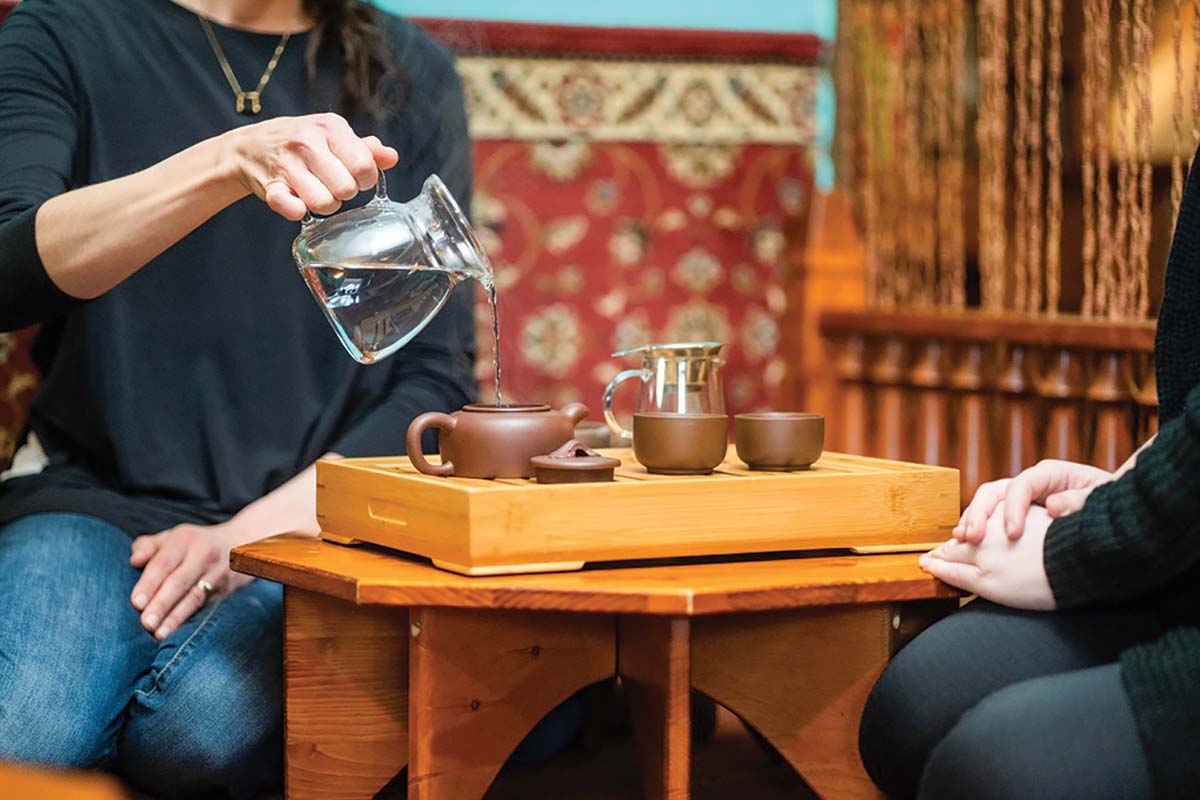
But the company’s roots are in Eastern Europe. Dobra Ashland, which opened in 2014, is the only West Coast branch of Dobra Teas, which includes approximately 30 in the Czech Republic, Slovakia, Hungary, and Poland, plus six in the US. The first US Dobra opened in Burlington, Vermont, in 2003, and three are in Asheville, North Carolina, where the first began in 2010. Each has a different look. In the waning years of Communism, tea lovers met regularly in Prague to savor fine teas smuggled in from China, Japan, and India. After Communism collapsed in 1989, two men opened the first Dobra in Prague in 1993.
A serene atmosphere permeates each Dobra. Travis Peterson, who owns the Ashland café with his wife, Nicole, explains, “All Dobras are co-designed with the parent company to have this feel and create a space for the community to not just sip tea but communicate with each other. I see people come in all amped up, who leave loosened up and feeling better and calmer than when they came.” A catalog on the counter describes the company’s mission—be a community center, protect health by a focus on organic teas, create well-being (both emotional and spiritual), favor forest-friendly farming, and philanthropy. All locations source tea together, since Dobra runs group tea trips—so far, Travis has traveled to India, eastern and western China, Taiwan, and Sri Lanka and to Taiwan with American and European branch owners—but source their own food.
Fittingly, Travis and Nicole (who created the recipes and is an acupuncturist) met and fell in love over tea in Portland, Oregon. The two became devoted customers of Dobra Asheville when they lived in that city. Though Travis’s career was in public health, he began to work part-time at Dobra and later full-time. When they decided to return to Oregon, they chose Ashland for its tranquility and opened a Dobra in a former sandwich shop. Dobra co-founder Jiri Simsa helped paint the walls of the café, whose distinct seating areas include a pumpkin-colored front room with tables, a window counter, a room with dark blue cushion banquettes, and a counter outdoors.
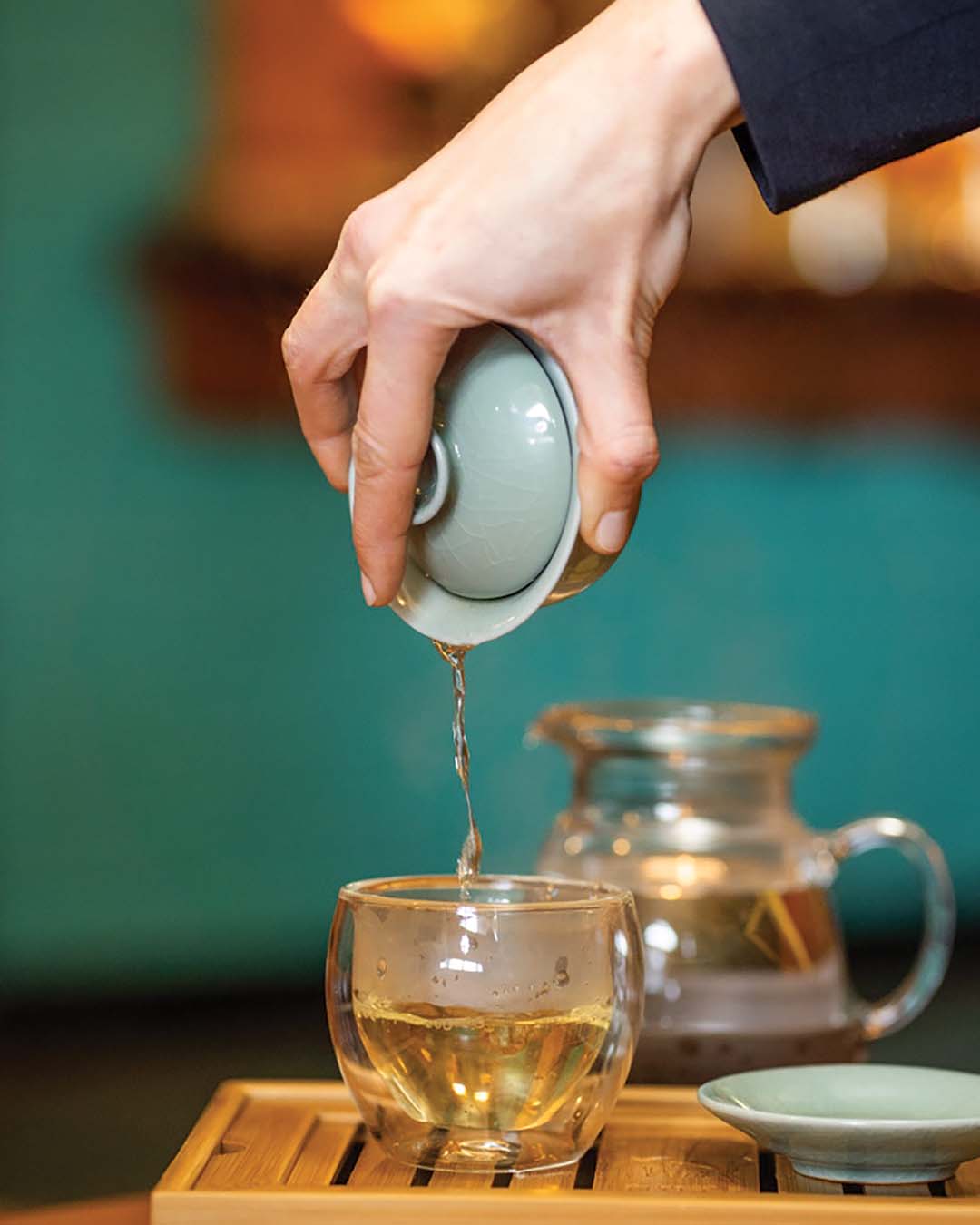
“Around the World in 100 Teas” is truly the motto here. At Dobra, you can sip everything from Memories of Prague (a black Indian tea with bittersweet chocolate, served with milk and honey), Forest Temple Tea (a white tea from wild trees by a Buddhist monastery in northern Thailand), Dragonwell (Lung Ching) from China, Moroccan green tea with mint to a robust-flavored red Turkish tea, served in a glass.
Dobra Tea is open daily from 10:00 a.m. to 9:00 p.m., except 8:00 p.m. on Sunday. Reservations are not required.
3. Chozu Bath & Tea Gardens
832 A Street • Ashland, OR 97520
541-552-0202 • chozugardens.com
A Southern Californian by birth, Ashlander by choice, but Japanese in spirit, Ilene Rubinstein owns an unusual tearoom–Japanese bath–and-garden combination. Growing up in Santa Barbara County, her best friend was Japanese, an exchange student from Japan who lived with her family, and she wanted to learn the language. “My love affair with Japan began very early on,” says Ilene. She first visited Japan in her 20s, where she stayed in traditional Japanese inns called ryokans, took cooking classes, and went to hot springs baths, called onsen.
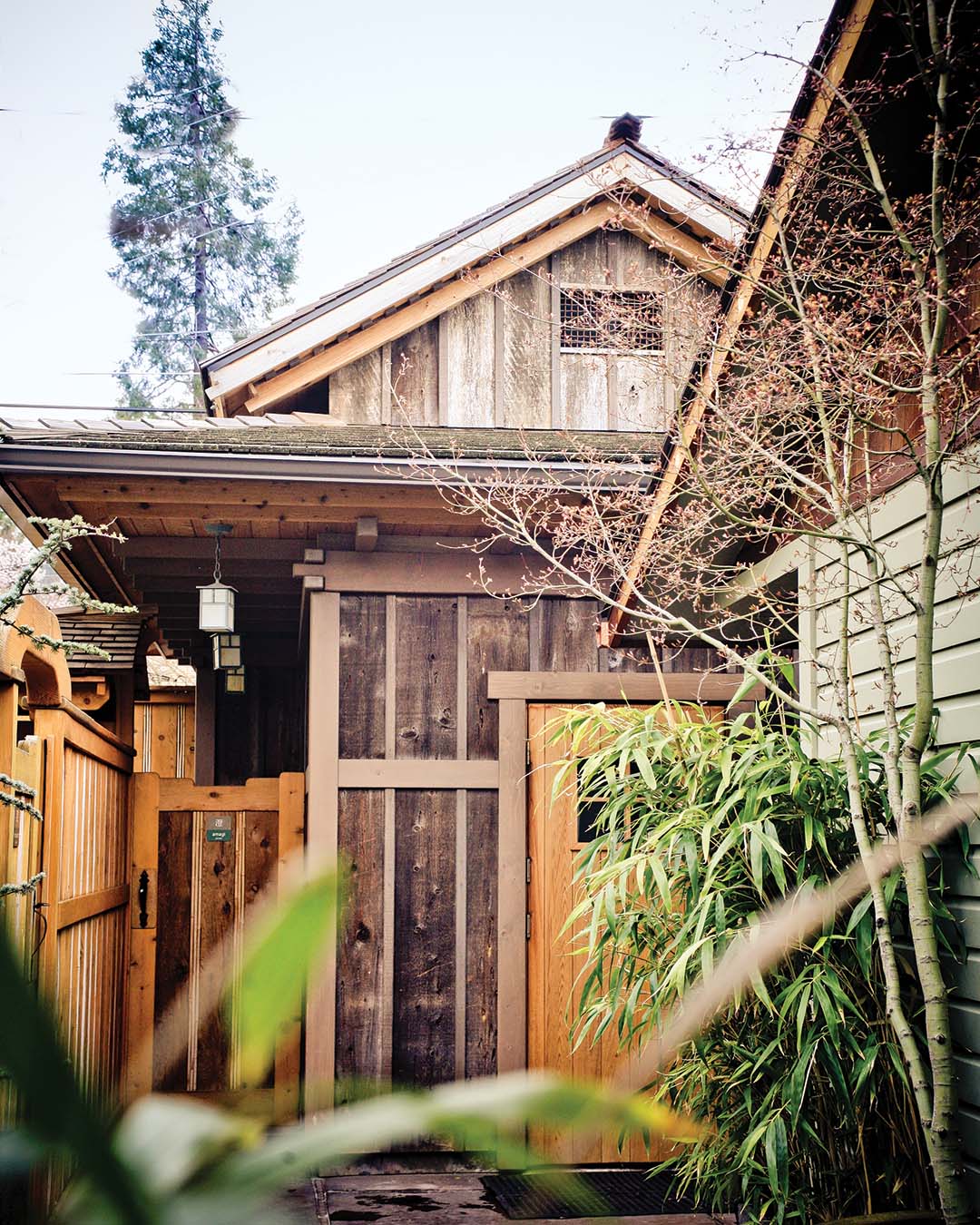
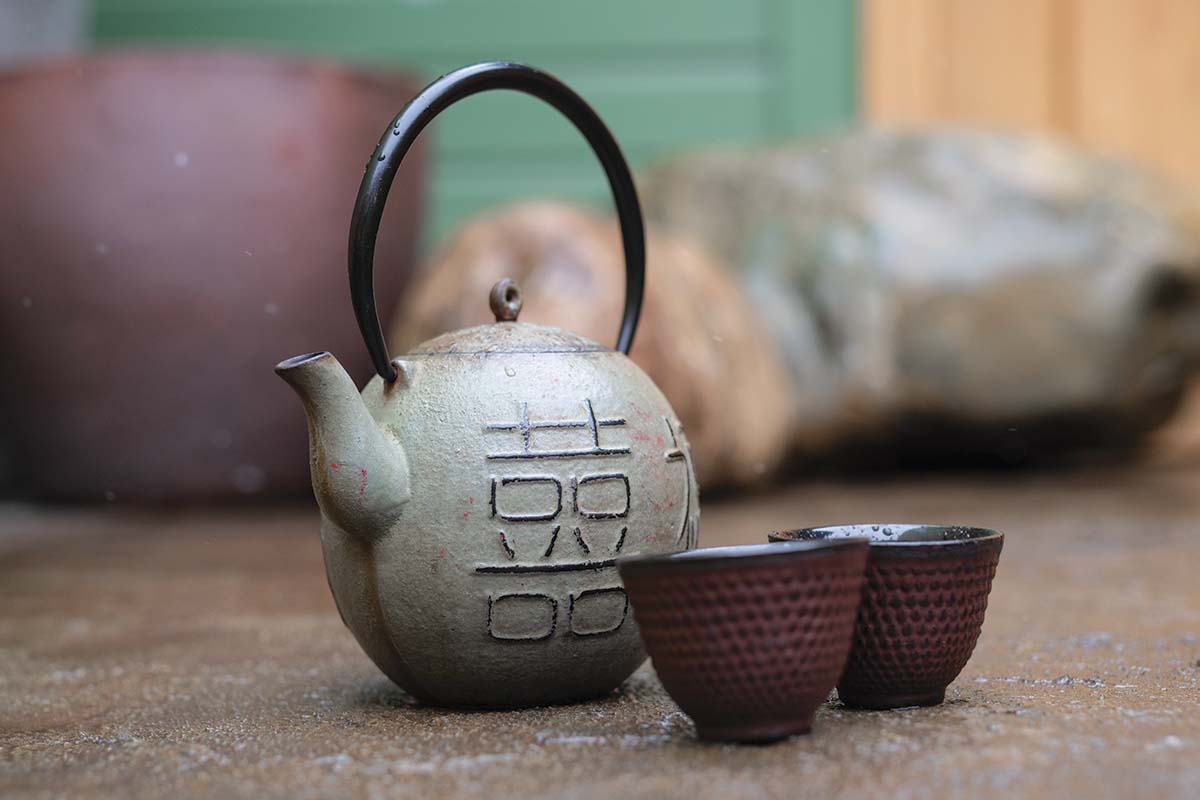
At Chozu, which she opened in a pale green 1903 wood cottage in 2006 after a three-year renovation, mostly green teas from Japan are served, but also oolongs and herbal tisanes plus matcha and black tea lattes. She says she whittled down her tea selection to what most people enjoy, using teas from MUJI in Japan and Two Hills Tea in British Columbia, Canada, after offering pu-erhs off and on. Traditional Japanese teaware is used, such as a side-handled ceramic teapot, a heavy black metal teapot, and handleless cups. Sake, wine, and beer are also served. Food served features maple-miso-glazed pecans, Chinese shrimp dumplings called shu mai, miso soup, and pickled quail eggs or vegetables.
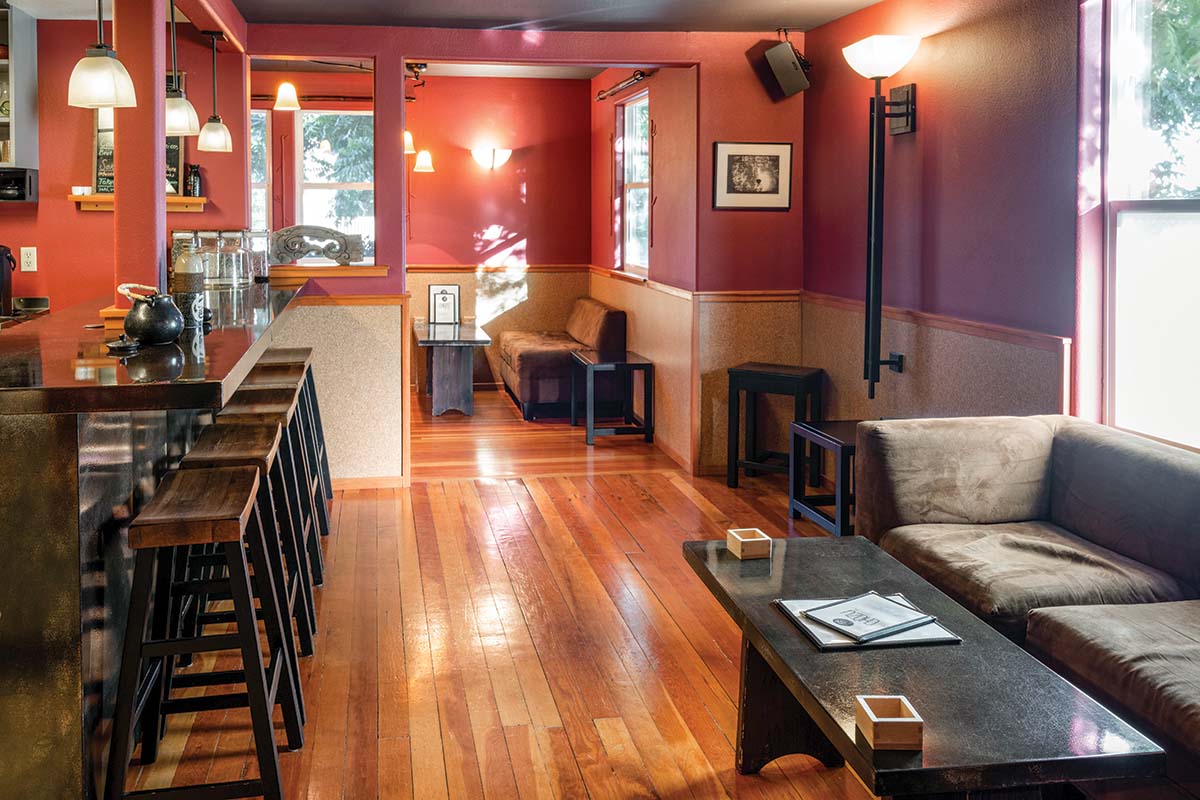
Comfortable cushioned banquettes and sofas furnish her serene tearoom, as do photos from her travels. A black iron kettle for heating water, which she bought in Kanazawa, a city in Japan known for centuries for teaware-making, is displayed by the order counter.
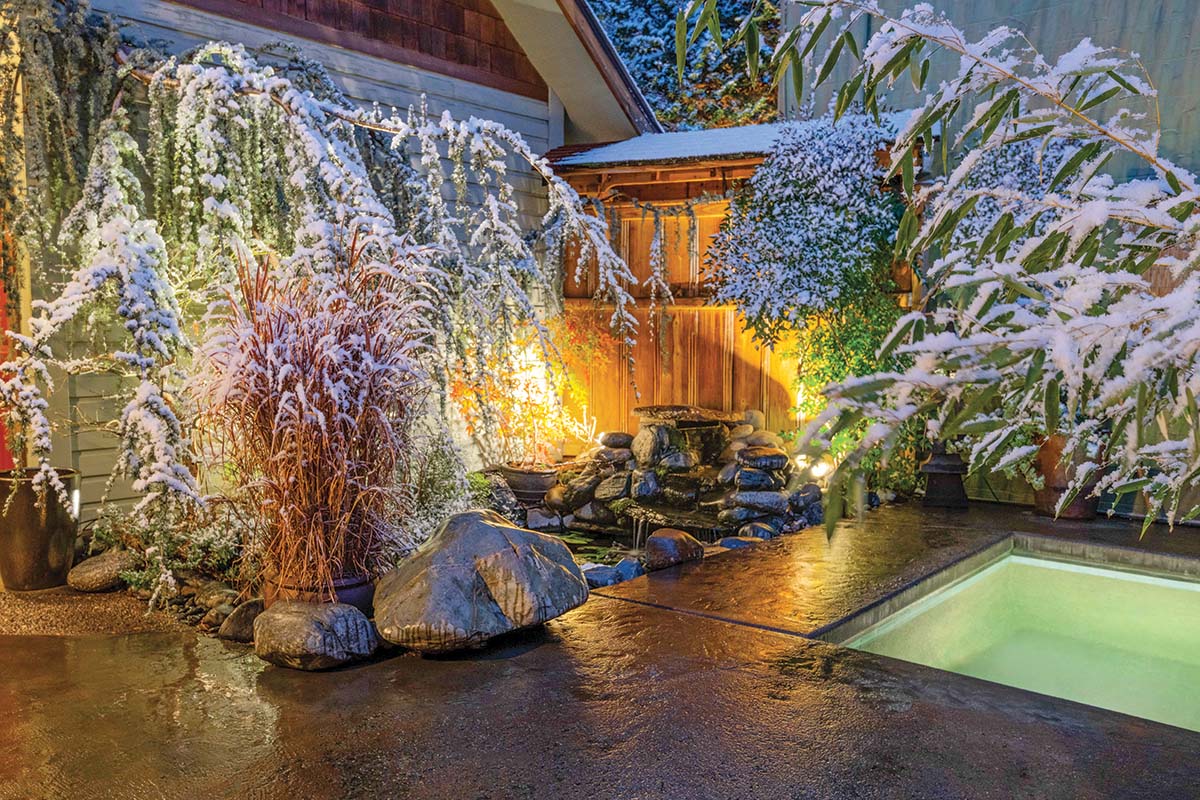
In the garden behind the tearoom, there’s a communal hot-water pool, a cold-plunge pool, sauna, and steam rooms amid bamboo, an unusual weeping blue Atlas cedar, and a rock-lined grotto with a tiny waterfall. When snow blankets the trees in winter, it’s simply magical. Bathing suits are required (unlike Japan, where they’re banned in onsen), unless you book a private pool, but you can rent a wrap if you wish. Three rooms offer treatments from massages, such as hot salt stone or deep-tissue massages, and body scrubs with bamboo charcoal soap to facials. A couples’ retreat includes tea or sake, lunch, bathing in a private pool, and a massage for each.

Most people come for the combined tea/bath experience, and some locals make a visit part of their regular health routine, she notes. “My focus is on health and wellness. Everyone can go and do their healing work, soak, drink tea, sit and relax, and love Japanese culture.” The tearoom’s name means “make pure with water.”
A chiropractor by training, Ilene explains how she came here. After her training in Portland, Oregon, she took over a chiropractor’s practice in 1997 for a three-month stint in Ashland, a six-hour drive south. “Ashland picked me, more than I picked Ashland. I fell in love with it,” she smiles, noting how her temporary job turned into permanent residence more than 25 years ago.
Chozu Bath & Tea Gardens is open Tuesday through Sunday from 10:00 a.m. to 10:00 p.m. Reservations for tea are not required but are needed for baths and treatments.
Sharon McDonnell is a travel, food, and drink writer in San Francisco who has taken cooking classes in China, Morocco, Italy, France, India, and Malaysia.