

Text by Margaret M. Johnson
Don’t let the name fool you. Clotted, or “clouted,” cream is one of the world’s loveliest, most decadent, and indulgent dairy products, a must for topping scones and the pride of two southwestern counties in England—Devonshire and Cornwall. It gets its name from the process of heating full-fat unpasteurized cow’s milk (many recipes use heavy cream), using steam or a bain-marie (water bath) until a semi-solid layer of cream forms on the surface. During the heating time, the cream content rises to the surface and forms clots or “clouts.” After cooling, the thickened layer of cream is removed (some recipes call for blending the thick top layer with the thinner bottom portion of cream), producing a luxurious, buttery, nutty-flavored topping for scones, one of the essential parts of an English Cream Tea.

For it to be considered authentic, clotted cream needs to contain 55 percent butterfat—for comparison, the fat content of regular cream, sometimes called “single cream,” is only 18 percent—and come from Devonshire or Cornwall. In 1993, Cornish clotted cream was granted the European Union’s “Protection of Designated Origin,” meaning it can officially be labeled as such if it’s produced from milk exclusively from Cornwall and it has the required percentage of butterfat.

Dairy dominates farming in these counties of England, which have a mild climate and rich pastures that make for the perfect environment for the local Jersey and Guernsey breeds to produce rich, creamy milk. Originally made by farmers to reduce the amount of waste from their milk, clotted cream has become so deep-rooted in the culture of the southwest that it’s almost considered a tourist attraction. Traditionally, clotted cream was created by straining fresh cow’s milk, letting it stand in a shallow pan in a cool place for several hours to allow the cream to rise to the surface, and then heating it either over hot cinders or in a water bath before a slow cooling. The clots that formed on the top were then skimmed off with a long-handled cream-skimmer, known in Devon as a “reamer” or “raimer.” By the mid-1930s, the traditional way of using milk brought straight from the dairy was becoming a rarity in Devon, because using a cream separator actively separated the cream from the milk, a process that produced far more clotted cream than the traditional method from the same amount of milk. As a farmer’s wife in Poundsgate once said, “The separator saves a whole cow!”
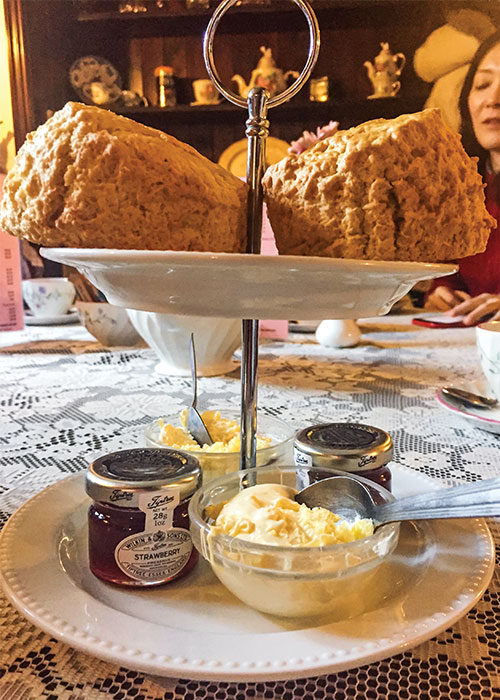
Ancient manuscripts show that the monks of Devon’s Tavistock Abbey were indeed the people who created the cream tea. The Abbey was plundered and badly damaged by Vikings in 997 A.D., and we’re told that local workers who helped with the restoration were rewarded “with bread, clotted cream, and strawberry preserves” made by the monks.

It’s long been disputed, however, whether clotted cream originated in Devon or Cornwall, which county makes it better, and, of course, the order in which you spread it. In the Devon way, you spread your scones with cream first and then top the halves with jam; in the Cornish way, you spread the jam first and then top with cream because, as the Cornish claim, “It’s the crowning glory of any scone!” Either way, clotted cream is an essential component of a cream tea (less formal than an afternoon tea and with no sandwiches or pastries), and it would be unthinkable to have a cream tea without it.

Throughout southwest England, clotted cream manufacture is a cottage industry, with many farms and dairies producing cream for sale in local outlets. It’s also produced in a few other southwestern counties, including Somerset, Dorset, and Herefordshire. Many supermarkets in the United States, as well as online sources (englishteastore.com, thequeenspantry.com, and tasteofbritain.com, for example) stock authentic clotted creams from the Devon Cream Company, a large commercial producer. The company also makes Devon Double Cream, a similar product with a less complex flavor that’s made by letting cream sit at room temperature until separation occurs (no heating takes place). The thick top portion is skimmed away, making its concentration so thick that it can be spread like softened butter. A 6-ounce jar of either costs approximately $8.
You can also make your own clotted cream in an Instant Pot or in the oven, or create a substitute by blending mascarpone cheese with whipping cream, 1 teaspoon sugar, and 1⁄2 teaspoon vanilla extract. Clotted cream— both homemade and store-bought—has a short shelf life and needs to be refrigerated; once opened, it will last for only 2 weeks.

- 2 pints (not ultra-pasteurized) heavy whipping cream
- Instant Pot Method:
- Pour cream into the Instant Pot; close lid; turn to YOGURT setting. Press button until it says BOIL.
- When machine beeps, press KEEP WARM button; leave for 10 to 12 hours.
- Turn machine off; remove pot. Let cool to room temperature without disturbing. When cool, refrigerate for 12 hours.
- Remove pot from refrigerator. Scoop off thickened layer of cream, leaving thin liquid behind*. Lightly whip the cream, and spoon directly into a glass jar with lid; or whip the thick layer with the thin liquid to make it creamier, but not as thick as clotted cream. Refrigerate for up to 2 weeks.
- Oven Method:
- Heat oven to 180°F.
- Pour cream into an 8-inch square glass baking dish. Place dish, uncovered, in oven. Leave undisturbed for 12 hours.
- Remove dish from oven. Let cool to room temperature without disturbing. Cover with plastic wrap; refrigerate for 12 hours.
- Remove dish from refrigerator. Scoop off thickened layer of cream, leaving thin liquid behind*. Lightly whip the cream, and spoon directly into a glass jar with lid; or whip the thick layer with the thin liquid to make it creamier, but not as thick as clotted cream. Refrigerate for up to 2 weeks.
Margaret Johnson is the author of 12 cookbooks, including Teatime in Ireland and Tea & Crumpets. She lives in New York. Visit irishcook.com to learn more about her.
Discover more seasonal recipes, table settings, and teatime inspiration by ordering your TeaTime subscription today!