
Tea remained popular with the wealthy until 1789, the beginning of the French Revolution. At that time, tea drinkers became suspect because of their decadence and indulgence in such an expensive habit. Many tasted their last cup of tea before their unfortunate appointment with the guillotine.
For nearly 60 years, tea drinking fell out of favor in France. Then in June of 1854, three brothers who ran an import-export business, Mariage Frères (the Mariage Brothers) founded a new tea importation business that soon became a resounding success. By that time, tea imports had become abundant, and the price of tea had fallen dramatically. Tea became available to anyone who wanted it. There were as many as 400 various kinds of tea that became available to choose from. In addition to the standard steamed but unoxidized green tea, the partially oxidized oolong tea and the thick, dark, fully oxidized black tea that the English favored were also available. Infusions, also known as “tisanes,” were viewed as having special effects. These were infused with fruit and/or herbs and were considered superior to coffee, which, at this time, was considered unhealthy. Many travelers used the tisanes to recover from jet lag after long trips. Today, some favorite French teas include black without either milk or lemon, thé au citron (lemon tea), thé au lait (tea with milk), and thé vert (green tea, usually Japanese).

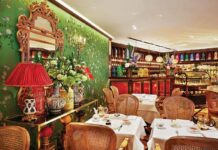
In the last 30 years, tea has made a remarkable resurgence in France. Teas are now paired with cheese in the best restaurants. It is not uncommon for a veteran tea consumer to request a tea grown at a specific estate, much in the same way that wine is selected. Classes on the finer points concerning the manufacture and consumption of tea are available at many of France’s colleges. Mariage Frères now has branches in London, Berlin, and Tokyo, as well as Paris. Visit any of its upscale salons in Paris to sample teas like Opium Hill (a “blue” Thai oolong tea), Neige de Jade (a white Darjeeling tea), and Gyokuro “Precious Dew” (a superior shade-grown green tea from Japan).
It remains true that the British still drink more tea than the French. However, the French have evolved into very sophisticated and knowledgeable consumers of tea.
Charles Bush, M.D., is a retired surgeon. He has been collecting paper antiques for more than 50 years. His special interest is in old postcards and advertising trade cards.