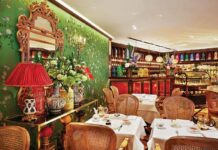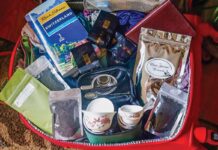
Another tea factory on the north coast, near Gorreana, is Porto Formoso, which grows black tea only. Tours and tastings, either on a terrace overlooking the ocean and tea fields or in a room modeled after a typical island kitchen, are available daily. The company operated from the 1920s until the ’80s, then closed, but was revived by new owners in 2001. Harvest season is mid-April to September in the Azores, so Porto Formoso holds a Harvest Start on the first Saturday in May, where more than 100 people pick tea by hand, to recall old-fashioned ways.
One of São Miguel’s loveliest sights is Lagoa das Sete Cidades, two lakes side by side, one luminous turquoise, one luminous green, divided by a thin strip of land and surrounded by cliffs 1,000 feet high and thick forest. The lakes formed in the crater of an extinct volcano,
7 miles wide, on the west side of the island, but legend tells the story of the doomed love between a shepherd and a princess. After the lovers parted, tears shed by the blue-eyed princess and her green-eyed beau created the lakes. A medieval legend says the name (“seven cities”) refers to towns now buried in the lakes but originally built by seven bishops who escaped to the island after the Moors invaded Portugal and Spain in 711.
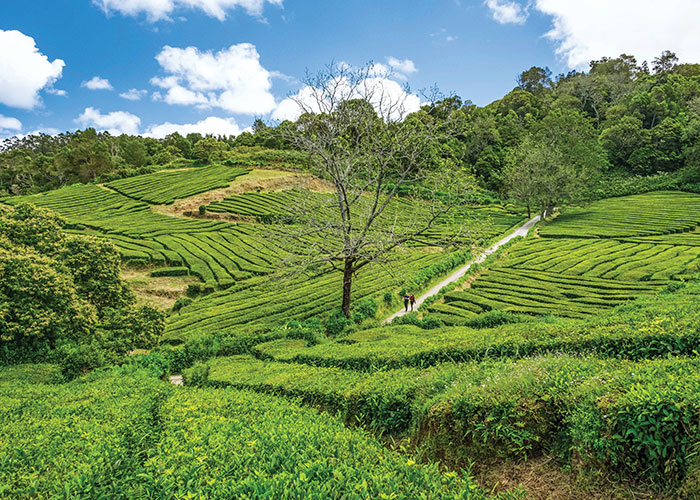
While most Azorean tea is the Chinese tea variety (Camellia sinensis sinensis), white tea of the larger-leaf Indian variety (Camellia sinensis assamica) also grows on farms in the small village of Sete Cidades and Ribeira Grande. The São Miguel Agricultural Development Service, who acquired the seeds in 1985 from Malawi in central Africa, manages the farms. “Due to the lack of adequate equipment to produce highly processed teas, experiments began to produce white tea, which is easier.
The buds—harvested before the plant’s leaves open fully, so they’re still covered by fine white hairs (hence the name “white” tea)—are just wilted and dried in a solar dryer built by the service,” Eduardo explains.
But whether it’s green, black, purple, or white, tea in the Azores comes with a heaping spoonful of history and tradition, with pristine nature on the side.

Learn more about Azores’ tea producers and buy their products by visiting gorreana.pt/en/ and chaporto formoso.com online. Gorreana tea is also available through amazon.com. Read more about the Azores at visitazores.com/en.
Sharon McDonnell is a travel, food, culture, and history writer in San Francisco, California. She previously wrote about tea and women’s rights and tearoom mysteries for TeaTime. Her website is sharonmcdonnell.contently.com.
Discover more seasonal recipes, table settings, and teatime inspiration by ordering your TeaTime subscription today!