Tea thrived in the Azores, which has a mild, humid maritime climate, after oranges failed. Oranges were the major export until a blight in the mid-1800s forced islanders to think up new sources of revenue. The first tea grown was planted in 1820 by Jacinto Leite on his farm in São Miguel, using seeds he brought from Brazil, then a Portuguese colony, where he was a commander of the Royal Guard in Rio de Janeiro.
At first, the Azores imported tea, which became popular throughout Europe after Portuguese and Dutch traders brought it from Asia in the 17th century. Since local farmers didn’t know how to produce tea, two tea experts from China, Lau-a-Pan and his assistant, Lau-a-Teng, were hired in 1878 by São Miguel’s agriculture promotion society to teach them. Tea production really began on São Miguel at Chá Canto plantation, located on the north coast in Ribeira Grande, owned by José do Canto. (Chá is Portuguese for tea: It’s also how locals pronounced the word in Cantonese in Macau, Portugal’s colony for 450 years, where tea was traded.)
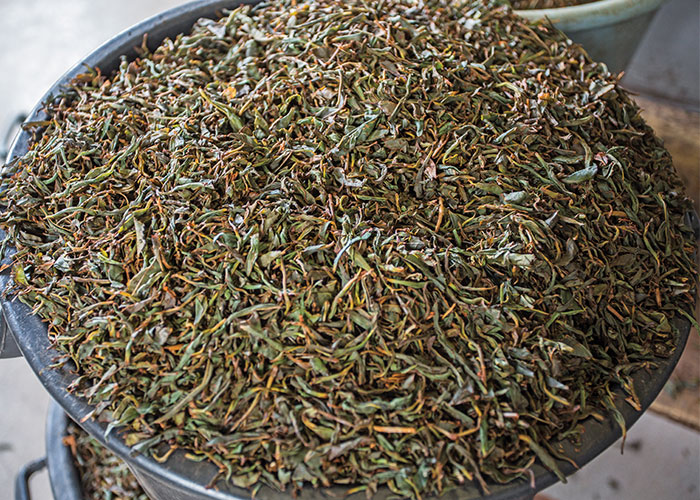
During the 1850s, tea production peaked in the Azores: 250 tons of tea per year were produced. Fourteen tea producers were in the Azores by 1899. In the early 20th century, new factories opened. But by 1966, just five remained, due to government policy to protect tea from Mozambique, then one of Portugal’s African colonies.
Gorreana also makes teas infused with herbs, like green hyssop with mint, cinnamon, lemon, and stevia, or green hyssop with local pineapple. In honor of Chá Canto, which pioneered tea production in the Azores but closed, Gorreana also sells a Canto Tea.
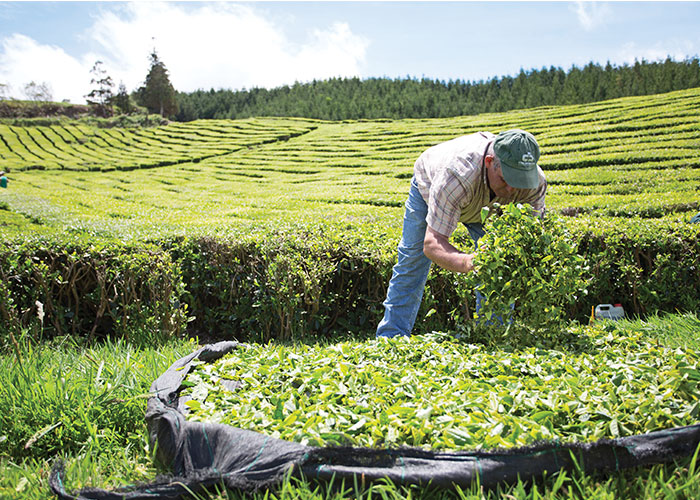
Fittingly, the family-owned company, now in its sixth generation, is headed by a woman today, Madalena Motta. “We always keep in mind not to tamper with the values of this house, to innovate, but always with the constant reminder of keeping the tradition,” says Madalena. Her father, Hermano Motta, trained her to take over leadership of Gorreana when she was 35. She was surprised he sent her to the packing room on her first day. But she realized it was a wise move, because “it is in the simple jobs that the most complex ones are understood.” Her childhood memories are of the factory as a magical, fragrant place where a raw material was transformed into tea.
An unusual purple tea made from Gorreana green tea is served at Chalet da Tia Mercês tearoom in Furnas, where hot springs and boiling mud pools abound. “The color results from the reaction of the antioxidants in the tea with the unoxidized iron and acid-filled content in the volcanic water, causing the mixture to refract light in a different wavelength—like a prism,” explains Eduardo Elias of the Azores Promotion Board. After tearoom owner Paula Aguiar fills a pot, Eduardo continues, “The geothermally warmed liquid requires no additional heating to steep the tea. Before long, it begins to turn grey, then lavender tones appear, giving way to a mesmerizing shade of violet.” Minerals in the water also mean the tea doesn’t turn bitter, even if it over-steeps. Her menu is one to remember: geothermally steamed cheese served with geothermal jam, and a gluten-free orange cake baked in volcanic soil. Visitors can also dine on a stew of chicken, pork, and vegetables cooked underground by geothermal heat elsewhere in Furnas.